VIDEOWatch
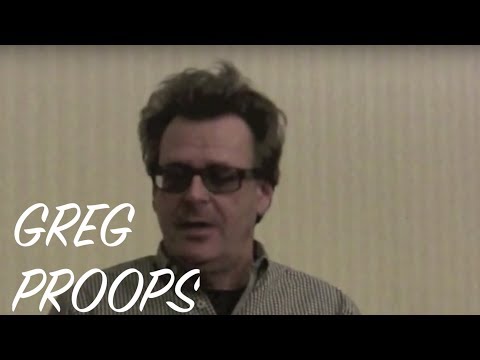
2 clips · 18:39 total
For licensing inquiries please contact reelinintheyears.com. How licensing works →
AUDIOListen
Episode #177 · Greg ProopsMarch 2010 · 00:22:21
TRANSCRIPTRead
Show full transcript
0:01Hi, hi, hi! Greg? Hello, Matt. Nice to meet you. Nice to meet you. Thanks for doing this. My pleasure. So you're up here doing stand-up. I wonder what your act's like, because you're an actor's actor, coming from the improv. Well, because, you know, the stage is your home. Film must be very different for you. I like live performing best, yeah. Yeah. I think you get the most honest reaction, and I think it keeps me honest as a comedian, because you can't fool them all the time. Is it, I wonder, the improv mind, is it always on? Gosh, I hope so. Especially for the purposes of this interview, right? No, yeah, obviously it shuts down sometimes. But, you know, I'm usually generally free associating. Or, Jordan, as I just said.
0:46Jordan, sometimes I use Jordan instead of sort. It's okay. There's no fair guessing on that. What is your act like? What are you talking about? You're talking about world circumstances now? Yeah, well, yeah. I talk about politics and being in Canada, and Canadian, and... Canadian. Canadian, and winning the gold medal, and all sorts of things. Are you going to come see it? Of course. Okay, well, of course. Well, you've been married 20 years now. I have been, yes. I'm sure that creeps up into the act as well. No, it doesn't. I never talk about my wife. I never talk about my personal life very much. I'm not a confessional comedian. I mean, there's a lot of comedians that are like, you know, Margaret Cho, or people that talk about their own lives a lot on stage. And I've just never, that's never interested me.
1:32How come? I'm not confessional in that way. I'm private. You'll get where I'm coming from by the jokes I tell and what I do up there. That's the end of our relationship. Fair enough. We'll be very intimate on stage, then you won't know anything about me. That's all right. Well, it's good. But you'll know a lot, if you know what I mean. Yeah. It's never been funny to me, one, to make fun of your wife, having said that, I adore wife jokes. And it's just not the way that I was bent. I would never talk about, you know, comics who have been talking about having kids or being clean and sober and everything. That's just not for me. I don't begrudge anyone their material. Lest another comedian should see this and think, well, fuck you, Greg. But it's just never been where I was coming from.
2:20That's all right. Well, you got your act and it's working well. Do you remember those first records, or was it records or was it stand-up? Like, what got you into stand-up? Well, I loved stand-up records when I was little. I had Bill Cosby, you know, like everybody that's from my generation from the '60s. And we memorized those records over and over. And then, of course, George Carlin in high school, and Cheech and Chong, and Richard Pryor. I think it was a golden age of albums in the '70s, because so many genius comedians were making albums. Later Robin Williams, Lily Tomlin. But I'm a fan of all of them. And I watched old movies, TV, the Marx Brothers and whatnot. And then the Pythons came to America about when I was in high school, which was well after they were on in England. But that was very exciting for us, the non-sequitur,
3:06abstruse humor that could be conceptual and completely open-ended. And Saturday Night Live came out about the same time. And there was something in the air then. I hate to use the word zeitgeist because it's overused and misused. But there was something in the air then, that there needed to be more calamity in the comedy, I think. And a little more information and a little more reflection, I think, of what people were about. This took place over a long period of time, but I think the '70s was a big culminating factor. Obviously, when you end up with people like George Carlin and Richard Pryor, who are so explicit about drugs and law and death and sex and poverty, those are the big comedy topics. And not everybody wants to, not even I will go there all the time.
3:52And then later I think Bill Hicks, when I was a comic in San Francisco. I'm a little older than Bill was. But he was very influential, I think, on a lot of comics, because he was so scathingly honest on stage. Brutally hilarious about the first war against Iraq, things that no one was touching, and abortion and Jesus and all that. And he was tremendous about that, very funny. And so I've always admired his comedy too. I saw Bob Newhart in Los Angeles last week. I went to see him speak. He's 80-something and he's got a new book out. And he was still dead funny. And I adore his style of humor, closer to Steven Wright, or right now there's a few guys pursuing it.
4:37And I'm going to blank on the name and I'm going to feel like an idiot. He's from San Francisco, Brent Weinbach. Brent Weinbach does a low-key deadpan. Margaret Smith used to do it. Laura Kightlinger does it. I can't do deadpan. I'm not very good at it. I can be a straight man and I can set up other people. Obviously I'm a team player, but I love that style of deadpan comedy where the next thing is a big surprise. Jake Johannsen does it somewhat, that style. Ellen DeGeneres always did. It seems like you're still a big fan of comedy too. Well, I do love comedy, yeah, most of the time. Well, I don't, you know, so I think comics, you know, this is my pretension, and I'm a pretentious guy in some respects.
5:23When you're starting, it's okay to talk about anything, because you don't know anything. Or if you're really young, you have no experience. You haven't been in a relationship, you haven't lost a job, you haven't fought a fight, and you know what I mean? Well, you're only young. Obviously they don't have a world to talk about other than the world of the mind, or as big a world, let me put it that way. Obviously Eddie Murphy was a fairly good comedian when he was 21 years old. True. But again, he was only talking about scatological stuff and sex. Men tend to talk about their penis to the exclusion of everything else, and that's where I get bored as a comedian watching other comedians. If you're going to talk about masturbating and watching pornography, you have to understand that the whole world doesn't live alone like you do, and that the whole world isn't interested in that. There are women and couples and relationships and other things in the
6:10world that you can sort of spread out to. And ocelots. And awesome ocelots. So that's not true. You don't actually own one. I own a herd of them, a lot of them. They're just frisky little cats. Little cats. They'll bite you. You know, they're peppy. Don't turn your back. Coming from San Francisco must have been, not easier, in a way, to get into the comedy world. But I feel like people would be more open to accepting jokes about various subjects, rather than in New York where they might be harsher. I think you're probably generally right. I mean, when I started in San Francisco, after World War II, it was a boom time in San Francisco. Robin Williams was our Elvis. He was already the big one. He'd made it and gone to Los Angeles. But his style, which is based a lot on Jonathan Winters' style,
6:59which is completely contemporaneous, using the stage as that platform for anything in the moment. He put it right in the act. The thing that him and Winters share is absolute total recall. Instantaneous total recall, which is why sometimes you think, what is he doing up there? He can remember everything that he's ever learned and heard and spit it back out in a second. So it's like a giant Rolodex: if something happens, he goes right to it, and within a second he's coming up with a new idea. There's something of that in the style of San Francisco comedy that I was raised in, in my 20s. My very good friend who passed away, Warren Thomas, I think was the king of it. We just called it riffing. You know, and jazz musicians call it riffing too. Meaning you start with your material, but then you
7:46go right off the rails and try to free associate. And because we're from San Francisco, we're insular and provincial, parochial, self-referential, and tried to be as obscure as we could be at the same time as going as fast as we could. So the whole idea was to sort of baffle and punish the audience at the same time as trying to be funny, and I think there was a lot more acceptance of that style of humor there. The comics that came out of that era are Jake Johannsen, me, Dana Gould, who's a genius. I say that because he came to San Francisco and was in the crucible there. Bobcat Goldthwait was in San Francisco then. I'm forgetting a bunch of people. Margaret Cho obviously was just a little tiny little prawn in those
8:32days. She was about 20 years old. And they all, there's an element that everybody shares, and even the later San Francisco comics, like Brent Weinbach, and I'm bloody blanking on his name, even Arj Barker, whoever you think of. There's a bit of that self-referencing. It's a little more abstruse. There's a little more hippie information. Comics in San Francisco tend to hardly ever be fascists on stage. There's a kind of a political set that comes with it. Whether or not you're explicitly talking about politics on stage, there is a political mindset from San Francisco. A kind of dope smoking, we love everybody, if you don't love everybody you're an asshole and fuck you. You know that. It's a different way, almost. It's liberal fascism in there. So I really believe strongly in that school,
9:18having worked with so many comedians then that were geniuses at that. A Bob Rubin. I don't know that he does stand-up as much anymore. And when you go to Los Angeles, I can take you to a show where there'll be a hundred comedians that are all born in the crucible of San Francisco. Chief amongst them Patton Oswalt, who has definitely come from that school. He's finally starting to get his due. Well, he's huge now, but like, I met him when he moved to San Francisco and he was young, and he was bathed in that with the rest of us. Brian Posehn, who's on The Sarah Silverman Program, was just a kid then. And we all work that way. You know, you listen to Patton and Zach Galifianakis, there's references from the movies and literature and comic books and the past and the future, and you know what I mean,
10:04and it's all over the map, and he's got a political set even if he's not talking directly about politics, and a little, I don't know how to describe it. I think there's a school, and I think I'm part of that school, and I think some of those guys are in that school, and I use the word school in the loosest possible sense. I don't mean that we all matriculated together, but we worked in clubs together for ages and ages and ages, and that was the motif. And as John Wing, who I'm working with here, says, you must put your imprimatur upon your material, which all of us have done. I couldn't do his jokes, you couldn't do mine. But I believe that there's, for lack of a better word, a big cloud that we all live in. That's different than an LA cloud or a New York cloud or a Boston one or a Denver one, or an English or Scottish or Australian. You know, they're
10:53all different schools. I'm sure Australians would say, well, those Sydney comics are different than those Melbourne comics, you know. Yeah, of course. Well, you've been all over the world. What was it like being in the UK clubs for a while? Well, it was fantastic. They're so creative. The style of stand-up is quite different, as you know, and there's only one or two comics that ever even made the attempt to breach it over here, chiefly Eddie Izzard, who's a delightful person. Sacha Baron Cohen wasn't a stand-up. He worked in a restaurant when I lived in London. He was a busboy at the Rosslyn Hill, or it was on Rosslyn Hill, I can't think of the bloody name, and they used to do like Wednesday night. He said he'd seen it, such and such, you know, he'd just go, but he was never a stand-up comedian. He's a character, you know, writer type. And, you know, Ricky Gervais, but he just
11:41came over, but he came over via sitcom, and now he's sort of doing some stuff. Well, Russell Brand as well. Oh, and Brand. Russell just came over like two years ago, and I've had him on my show in LA a bunch of times, and he's really polite and intelligent. Heavy on the knob gags. Yes, you see. Heavy on the knob gags. If you like knob gags, you'll like Russell. But I mean, I enjoy Russell's style. I think it's in the grand style of eccentric English comedians. He's adopted this rock and roll Lord Byron thing, you know, which is a really old idea, but not for the 20-somethings of today. It's new to them. When a guy with long hair gets on stage and he's, you know, and he's walking through his life. Yeah, yeah, yeah, you know, and all that. You know, Tom
12:30Rhodes, who is another San Francisco comic from my day, he's pulled back on all that, but he used to have really long hair, and Tom would totally do this like flowing tai chi thing on stage. You know, and I see some of that in Russell, but more of a rock and roll, fancy-dancy, you know. I mean, when I work with him, the few times I've worked with him, you've got to keep running up and down the stage because he won't stand still. You can't get him to sit, he's right out of the chair and he's up and running. Like Robin, too. And Robin has to do whatever he's up and fucking doing, a second into working with him. But, you know, Russell just came over. He's the newest and latest, and there's been a lot of reciprocity. I've gone over. Rich Hall's really popular there. Arj has gone over, Scott Capurro. I'm forgetting. Mike Wilmot from Canada, I think, is a resident in London. I used to.
13:17A bunch of us go over, or have gone. It's more, I don't know if it's more difficult. You know, Eddie hasn't had a problem cracking it over here. American audiences understand utterly, and also American audiences adore an English accent, and it immediately elevates the comedy in their tiny brains, that somehow these people are smarter, which is hilarious. But it doesn't work the opposite way? Generally, well, it does. I've had great success in England, but the style of comedy, English stand-up comics sometimes are a little like, for instance, there's a comic named Al Murray who's a character called the Pub Landlord. It would work in Canada, and it would even work in America a little bit, but the idea of a pub landlord is a very specific thing. You know what I mean? It would be like American, I don't know.
14:03You'd get it in Boston or something. Yeah, you know, and he plays the racist, sexist, you know, landlord of a pub, time, gentlemen, please, you know, and all that. I just don't, I'm not singling Al Murray out. Somehow he'll watch this on the internet and go, Proops, you know, really? I just don't know that they all, the timing translates, and some of the specificity about England is a bit, we're not that literate in America, and I'm saying America, not Canadians, because Canadians are much more connected to England in some respects. We're on the wrong. I understand English things a little more. We're coming home. We work a little bit until like 50. You get English programming more. There's just a little more understanding of it. We say zed, you know. Well, we got the UK version of
14:51Whose Line. Oh yeah. So what was it like? Because, I mean, you understand on stage you can be very free. You can say basically whatever you want, but on TV it's very different in the States compared to UK TV. You're a lot more free in the UK to say more. We were. We could do longer things. There was more air in the show, simply by the nature of, in those days a half hour was 24 and a half minutes, I think. An American half hour is 22. 22, yeah. And so you had an extra two and a half minutes. We used to do full musicals and stuff like that. And they weren't as censorious. They had censors, but not, and maybe when we did it on ABC a censor sat in the booth and watched the show and ticked off things that they didn't like, because we weren't able to present them with a script beforehand. No, of course. So they had to actually physically appear at
15:36the show, which I found hilarious, and I was forever being censored even though I would never say, I mean, obviously if you cursed, that was how you could get them to stop tape. Yeah, if we were failing, we would just curse, and then they'd stop and we'd reset, so we'd get another go at it. That's smart. But, you know, I would go like, hey, that's a nice shirt, and everybody would go, ooh. Like, for some reason everything I said was laden with double entendre, and they really picked on me, I felt like, the censors. That somehow they were, you know, what's he doing, you know, what's he saying, what does he mean, you know. I think they were determined that I was trying to get some filth on their air to bend America's minds. And, you know, we were the gayest show on television. If there wasn't
16:23a sketch where we weren't dating each other, on top of each other, rolling around with each other, kissing each other. I mean, you know, the female presence on the show was light, and I remember kissing Colin on the mouth on the show. I mean, you know, everything. And in our live act too, it's the same. It's just a total slash, you know, an S&M fantasy. What is it about comedy that's so free? Because you see it on SNL now all the time too. It's the playground. You're allowed, one, we're allowed to be children, and two, we're allowed to act out the things that people maybe wouldn't think of acting out. On stage, it's a release valve. The theater is a release valve for people's lives and stuff, and you realize things are horrible, or maybe you get drunk and act like an idiot with your friends, but you don't
17:08organize it the way comics do. And I think there's a certain thing that people, you know, we were talking about the other day, with the internet and texting, you know, and oh my god, the world's so isolated now, everyone's on their computer all day. People still pay to come to comedy clubs, or I wouldn't be working, and I think that's because they want a connection with other people. They want to hear about all the things that are in the air, they want to hear them expressed and dealt with and made fun of. I think that people want that, there's a need for it. I call it theater, but I mean it in the sense of, you know, most people don't go to the theater, or, to generalize horribly, you don't go to see plays as much as you might go see comedy, most people, I think. Some people
17:56obviously like theater, go to more, but to me it's like theater for everyone, or a little more commonality. You don't have to be a subscriber to get a good ticket to a comedy show. You can sometimes pitch up on the night and sit right in front, right? Whereas if you want to go see a hot play, you either got to belong or, you know, finagle, because it's a different kind of thing. And then the parameters of theater are so constrained that things that are really funny on the theatrical stage wouldn't even play on the comedy stage, and things that play on the comedy stage would be far beyond the pale on the theatrical stage in some senses, for, you know, for nice people's theater, not experimental theater. Right, of course, avant-garde or whatever. People come to see you, I'm sure they're coming to
18:43see stand-up, but they're probably also going to see some improv. Well, I improvise, I improvise, but not formally. I would never ask anyone for a suggestion. No, I don't do any of that, because I do that with the boys I play with: Ryan Stiles, Chip Esten and Jeff Davis. Bob Derkach is our musical director. He was musical director of Second City Toronto for 25 years. We tour as a group called Whose Live Anyway. And you're coming back in a few weeks. We'll be back in a month's time. Jack Singer. Yeah, and we've played Calgary many times. In Vacherastia, Chinese food. And that's what you remember of Calgary, the Chinese food? Okay, where I stay and what we eat. I'm your Jewish 80-year-old grandmother. Everything is done for my personal comfort. I remember if the food was good and I remember if the room was okay. We did some gigs in Pittsburgh last year, and before
19:32we did a gig up in Mississauga, and the first hotel was so skanky, and I hadn't stayed in one in such a long time. That was, you know, the bad air conditioner that runs poorly, and then the window, and like cigarette burns, and I called our producer, Richie, and I said, let me ask you something, Richie, are we on the lam? Is the federal government pursuing us? Because I'm not sure why we're staying at this fucking, you know. It was because the gig was paying for it or whatever. Also, the town we were in, to be honest, that might have been one of the only choices to stay. It was a small place. Oh, that's Pennsylvania. But so, that's a lot. Yeah, I can't remember the beginning of your question. Oh, so I play improv with those guys, so I don't do it on stage. You know, at stand-up, I have the conch, right? And so it's my time, not the audience's time, whereas when I'm with the group,
20:22the audience is absolutely involved, because improv is all two-way. Do you like one of the two better? No, I like them both for different reasons. You know, playing with Ryan, Ryan Stiles, is like playing with Babe Ruth. You know, he just points at the fence and then hits one over the wall, and then children cry. He's a tremendous improviser and he doesn't give up. He fights like a tiger. And Chip and Jeff are just dead funny, and we've been working as a foursome for several years now, and we've got it whipped into a, you know, a thing. We hit the stage running and we're really lively and we really throw down. So if you come to see us do improv, it's really good, as far as, you know, we're not distracted, we're not thinking of
21:09something else. We're really there for the crowd that night, and we put it together. Stand-up is my opinion, what I think, how I feel, all shot through my writing and performing. So the difference is like total. You know, I can't stop the improv show to put in jokes that I've thought of about topics I care about. I have to go with the big wash, and that's how improv works. So that's more like being in a band, and being a stand-up is more sad and lonely. Oh, I'm joking. It's a fun life, though. The crying need to have the attention of a total room full of strangers and have them laugh at what you say every 15 to 30 seconds. It is a fun life. It is a fun life. I wouldn't do another life,
21:59because, one, I have no skills, and two, I've worked in offices, and, you know, I've been a janitor and a waiter and a busboy and everything like that, and it's not that great. I understand what it's like for people when they come and they're tired from working and looking after their families, and you're there to entertain them, and there I am to be their dancing monkey clown. Thank you. All right, thank you.
ABOUTThe archive
This interview is part of the Matt Schichter Interviews archive: more than 700 conversations with musicians, actors and filmmakers recorded between 2003 and 2014, beginning with The BackStage Pass, one of the first podcasts (2003). The archive also became Matt's short documentary Lennon or McCartney. Matt Schichter is now a Glasgow-based producer, line producer and music documentary director: he directed CFNY: The Spirit of Radio (PBS, TVO) and line produced Faith (TIFF and Rome 2026). His films → · UK film producer and line producer → · More about Matt →
Listen to the full archive on Apple Podcasts or Spotify.