VIDEOWatch
6:23 total
For licensing inquiries please contact reelinintheyears.com. How licensing works →
TRANSCRIPTRead
Show full transcript
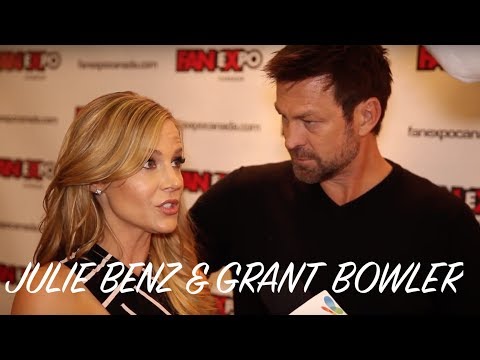
0:08It was bought. It's not. It's great. So you did... I'll get to you in a second here, but we're having a little moment. Aw. You went to a lot of trouble tonight. You have that moment. You've earned it. Aw. You did, like, all my favorite shows as a kid. I did. Step by Step. Boy Meets World. I did. It's pretty cool to see you right now. Oh, thank you. And Richard Burton over here. I liked it. Yes. That was your Burton right there, the wink. Yeah, that's all I got. That's all that's left. The residue. I'm back in the Badlands now. Yeah, right. Like, you guys are in the middle of shooting everything. Yes. And I was just asking everyone else, and I know this is the hardest question,
0:45because everyone wants answers. You can't give answers, but you want to be nice and try and give answers. So what can you say about season two? Julie? Oh, yeah. Give it to her. I know. Thanks, Grant. Tough one. I'll give it to her. Thanks, Grant. That's a great thing about sci-fi. It promotes strong female characters. So Julie will answer all the hard questions today. No, I mean, I think what happened at the end of season one is the reset button was hit, and we see in season two the whole world has changed, and all the characters have as well. With my character specifically, Amanda starts in a much darker place. She lost her job, she lost her sister, she thinks her sister's disappeared, she doesn't
1:25know why. She's in a very, very dark place, and unemployed. And when you're unemployed and you lost the one person you love, you don't have much to cling to except a good glass of scotch. She's on the loud house. She's on the drink. She's on the wahwee sauce. So she's in a very dark place. And what about you? He's always in a dark place. So, you know, there's... But what Julie says is true, is we've discovered in the first season, we've gotten to know the characters, we've gotten to know the world. We've gotten to figure out what the seven races are, all these different cultures, the languages and everything else. And then what they've done is they've basically gone, okay, now you know what they're all about, now you know what they all want. We'll strip
2:12all of that away from them. So everyone is back not having what it is we know they want. And then now in the struggle to just get back the basics, get back to where they began in the series. And my guy included, you know, his daughter's disappeared, he has nothing officially to do with Defiance anymore, he's back roaming around the Badlands, you know, searching. Can you talk about that, just the intricacies? How did you all wrap your heads around the story, forty years from now, all that stuff that has happened to get to where the show starts? Well, you know, the show itself was five years in development before we showed up, so they had pretty much a Bible written of how each character got there from
3:032013, before the war. So it was a lot of research and a lot of picking the minds of all the creative team behind it. Yeah, and a lot of learning on the run. Some of the mythology, and I think that this happens in any creative process, some of the mythology actually evolved with the creation of the game and the making of the show. So there's a great deal of the rules, if you like, that we only came up with as we were shooting. For instance, I remember one big one was, while we were shooting the pilot, Julie's character, when she was doing the first couple of speeches, had this lovely hand-pulped paper. And a very early decision that had been made was, well, if you're reconstructing the world, you know, do you bother recreating printing presses?
3:45That's an enormous output of energy. Or do you just hand-pulp the paper? So Julie's character had that. Then we had to go across to the game and make sure there was no paper anywhere that existed in the game. And then when we went back out of pilot into series, I walked down the backlot on the first day, and we'd changed our standby props department, and blowing down the street was all this newspaper because it looked so good. And I had to turn around and go, I'm so sorry, boys, you've got to go and pick every piece of paper up, because paper doesn't exist anymore. So a lot of that mythology we create as we go, and then the hard part is keeping track of it all as you move forward in the series. I think one of the most important compacts we make with our fans in science fiction is honoring
4:25that mythology and making sure that we always stick to it. Yeah, I remember the Lost guys saying that they had a guy who was strictly looking at the board, making sure everything... because people, especially now with Twitter and the internet, everyone is a critic and everyone can be like, no, that's not going to work. Speaking of Lost, I was at Comic-Con two years ago, and these guys came up, they had a piece of the plane. They actually had a piece of the fuselage, and they bought it somewhere, and they had every single actor who'd ever been on Lost sign it. They were only missing three, and I was one of them. And they said, would you sign it? And I was there with something else. And I said, of course,
4:57you've gone to this much effort. So as I'm signing it, they said, you know, when you're on the freighter in Lost... I played the captain of the freighter in Lost. And they said, when you were on the show, you didn't know. So when you're on the freighter and you pulled out the flight recorder from the flight, and I went, yeah, I'm throwing my mind back four years. They said, and you picked it up, you put it on the table. I'm like, yeah, how do you remember that? And they said, the flight recorder was burnt. And I went, right. And they went, if the plane went into the ocean, why was the flight recorder burnt? And I looked at them and I went, because the art department gave it to me that way. I have no idea. The fans knew
5:31more than I did. And I think with Defiance it's the same thing. Yeah. Are you noticing that, especially walking around this weekend? Oh yeah, the fans know more than we do about our own show, definitely. Is that a good thing or a bad thing? No, it's a great thing. It's a great thing. I've always said that it's so great to be part of a show where the fans are just as passionate about it as we are making it. And so to have that passion, to have people really watch it, and they're really studying everything about it, it keeps us on our toes, and it makes us love even more what we do. That's a good closer: love what we do. Thanks, guys. Thank you so much. Appreciate it. Thank you.
6:06I just want to wrap your tickles. You can do it. We like it too. You get out here, Dave. All right, I'll let you go. Let's get out. We'll get out of here.
ABOUTThe archive
This interview is part of the Matt Schichter Interviews archive: more than 700 conversations with musicians, actors and filmmakers recorded between 2003 and 2014, beginning with The BackStage Pass, one of the first podcasts (2003). The archive also became Matt's short documentary Lennon or McCartney. Matt Schichter is now a Glasgow-based producer, line producer and music documentary director: he directed CFNY: The Spirit of Radio (PBS, TVO) and line produced Faith (TIFF and Rome 2026). His films → · UK film producer and line producer → · More about Matt →
Listen to the full archive on Apple Podcasts or Spotify.