Lennon or McCartney? Alanis Morissette’s answer: Lennon. Watch the moment. See every artist’s answer. Take the quiz.
SONGSWhat Alanis Morissette said about the songs
“Guardian”
Alanis Morissette explained that the chorus and the verses of "Guardian" are about two different relationships.
“the chorus is about my wanting to protect and safeguard the freedom and the safety for my son... And then the verses were really about my realizing that if I was offering this consistent connection and attunement to my son, that I might benefit from offering that to my very own self.”
“Lens”
Alanis Morissette described the stalemate behind "Lens" and how it ties to "Win and Win."
“Lens, I was going through something where, you know, these two perspectives, mine and another person's, were so vastly different, and we were in this stalemate, you know, and I loved her so much... we just couldn't get past this difference of opinion, which really brings it to what the song Win and Win is about”
VIDEOWatch
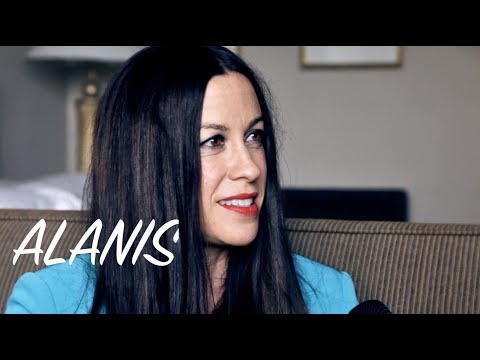
2 clips · 6:17 total
For licensing inquiries please contact reelinintheyears.com. How licensing works →
AUDIOListen
Episode #385 · Alanis MorissetteAugust 2012 · 00:05:22
TRANSCRIPTRead
Show full transcript
0:17Havoc and Bright Lights. Havoc is a very... it evokes a lot of emotion as a sentiment. Bright Lights could... so are they opposite, are they similar? I've been obsessed with wholeness for a long time, as opposed to attempting to be good or perfect or right. My main aspiration is to be whole, you know, so that means integrating everything. It means integrating the rage and the joy and the frustration and the exaltation and the fear and all the sweet, vulnerable human aspects of being alive. There's some juxtaposition on the single too, that we all know, Guardian. Yeah, the chorus is about my wanting to protect and safeguard the freedom and the safety for my son, which is a delicate dance for any mom or any dad, really. And then the verses were really about my realizing that if I was offering this consistent connection and attunement to my son,
1:07that I might benefit from offering that to my very own self. So the verses are about my journey, you know, my inner mom or inner dad attempting to take care of my inner child for what might be, consistently, the first time, I'm ashamed to say. And then the chorus is about me and my son and that protectorship, you know, the first time that I'm appropriately, maternally caretaking, you know, because caretaking ex-boyfriends and caretaking people that it's inappropriate to do, you know, it's a sad state of affairs. Writing a record knowing you have someone else that's going to hear every word, are you more cognizant about what's coming out of you? No, not in the self-conscious, intellectual way. I write songs for myself first and foremost. It's really diary entries made musical. And
1:57then secondarily I offer it to people. And once the records are released, it's really about people making it their own, you know. So I think any artist in their right mind is really writing for themselves, you know, and it's really a cathartic experience, and therapeutic in that sense, but it's not healing. You know, I always thought that I could get away with writing about all my quandaries and my challenges in the studio and never having to deal with human beings, because I was so terrified and shell-shocked and PTSD around, you know, some of the conflict aspects of life, and, you know, women are encouraged not to be angry and not to express themselves in that way. So what I'm doing now is I'm taking the courage that it takes to write these songs and I'm applying it to my relationships. And there's so much healing. I think, you know, commitment and intimacy is commensurate to the degree of healing that's available. So while the songs are
2:46definitely cathartic, and philosophical in that sense, the real rubber hits the road when I apply that courage to my relationships. That's very deep. I don't know where to take that, but I want to go to... Just have a moment of silence. Well, you talk a lot about a lot of stuff on the record, even a tune like Lens, where you're bringing up religion and politics and things that are... they're not off topic in music, obviously, but they're difficult to write about at times because you want to... I don't know, you don't want to make people upset, but you do want to make people upset at the same time. Well, I don't want to make people anything. I just want to write about what I care about, you know. So that particular song,
3:31Lens, I was going through something where, you know, these two perspectives, mine and another person's, were so vastly different, and we were in this stalemate, you know, and I loved her so much. I love her, and at the same time, we just couldn't get past this difference of opinion, which really brings it to what the song Win and Win is about, which is whether it's a professional relationship or a romantic one or any relationship, frankly, that it's got to be win-win or there's no deal to be made. I think the new paradigm is about partnership. The evolution is taking us to a point where hierarchy and role playing is really valuable. You know, if we're attempting to have a similar true north and all work toward the same goal as a group, it's really valuable for
4:17everyone to know what their roles are and to work together, but not to ascribe higher or lesser value to any contribution, you know. So partnership in my marriage, in my friendships, everything. If there's not a mutual benefit, what are we doing? We can't be here. We do something called five questions: five quick questions, one-word answers. One word. One word. Well, you try. Road or studio? Studio. Lennon or McCartney? Lennon. When you hear a song, what usually hits you first: lyrics, melody or rhythm? Lyrics. Song you've written you're most proud of? Doesn't need to be one word. Thank U. Oh, yes, the song. Thank U. I was like, thank you, me, for it. Yeah, no. In one word, Alanis Morissette? Brave. Brave. Thank you very much. Much appreciated.
ABOUTThe archive
This interview is part of the Matt Schichter Interviews archive: more than 700 conversations with musicians, actors and filmmakers recorded between 2003 and 2014, beginning with The BackStage Pass, one of the first podcasts (2003). The archive also became Matt's short documentary Lennon or McCartney. Matt Schichter is now a Glasgow-based producer, line producer and music documentary director: he directed CFNY: The Spirit of Radio (PBS, TVO) and line produced Faith (TIFF and Rome 2026). His films → · UK film producer and line producer → · More about Matt →
Listen to the full archive on Apple Podcasts or Spotify.