Lennon or McCartney? Dan Smith, Kyle Simmons, Will Farquarson, Chris Wood answered: Lennon, Lennon, McCartney. Watch the moment. See every artist’s answer. Take the quiz.
SONGSWhat Bastille said about the songs
“Weight of Living, Pt. I”
Dan Smith explained why Part I closes the album while Part II sits in the middle.
Dan Smith: “I had almost too many ideas for a song. So it very much became two songs... 'Weight of Living, Pt. I,' I think it's a bit more optimistic than 'Weight of Living, Pt. II.' And so I kind of wanted to end the album on a lighter note.”
“Bad Blood”
Drummer Chris "Woody" Wood explained why the title track was the hardest to play live.
Chris "Woody" Wood: “the title track was the hardest one for me, because that was programmed drums. It's kind of hip-hop and that sort of stuff, so a real kit wouldn't have sounded right.”
VIDEOWatch
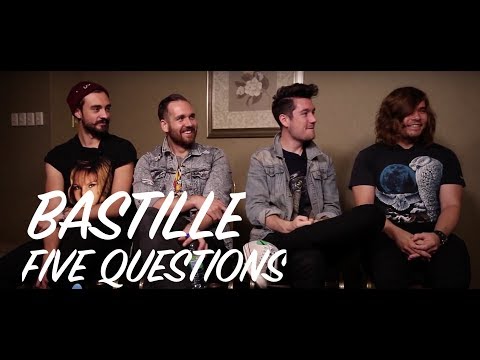
4 clips · 17:54 total
For licensing inquiries please contact reelinintheyears.com. How licensing works →
AUDIOListen
Episode #584 · BastilleAugust 2013 · 00:12:37
TRANSCRIPTRead
Show full transcript
0:06Hey, we're Bastille. Or Bastille. You're watching MSN. Ah. That's done so well. I've got a little card and everything. One sentence. MSN Exclusives. Hi, we're Bastille and you're watching MSN Exclusives. You put your eyes... Who doesn't know? So, Bastille, with the video, we discovered Dan is a prime athlete. So this required showcasing. Yeah, we've got a video built around Dan running. Yeah.
0:51I go with it. When we were planning the video, I got really into the idea of it being this sort of slightly post-apocalyptic thing that sort of gestured towards some sort of big dramatic event, like, obviously, a volcano-type thing, but not, something else. And so I got really into the idea, and the script was awesome. And I just massively overlooked the fact that I had to play the lead character. So suddenly I was on the set of this video and they were like, right, so now your motivation is you're furious and you're scared, and kick the car. I had to start kicking and smacking this poor unsuspecting car in the middle of the desert. But it was from that moment onwards, the next two days of my life, I was like, oh, I'm acting. This is awful.
1:37And I'm running, which I also can't do. And this is potentially going to be seen by a few people. It's a matter of time until Hollywood comes calling, I feel. I'm using that. Well, David Lynch, right? Didn't one of you meet him recently? Yeah, I met him. I'm sorry, I had to do it. There it is. Right after the mention of David Lynch. Yeah, no, we did a remix of one of his songs off his new album, which was insane to be able to do. And then, off the back of that, we were in Los Angeles back in July, ended up going to his studio house thing and just hanging out for an hour and having some coffee, which was wicked. Even the cover of the record, I was just telling you guys, it kind of reminds me of Lost Highway. And I was obsessed with that soundtrack, back when people still bought the actual CD soundtrack. I remember those days.
2:23And the Pumpkins had the song "Eye" on it, and I just love that tune. And what's interesting about this record, too, is I like the little film thing at the bottom. But so, "Weight of Living, Pt. I" is not officially on here, but it's at the end nonetheless. So "Weight of Living, Pt. II" is in the middle of the record. Part I closes the record. This is reversed from what I would expect. Whose idea was this and why? Yeah, it's a bit weird, isn't it? Did you just rename the titles? Or did that song have to sit in the middle, but it was the second half? No, Part I came first and then Part II. It's basically, I had almost too many ideas for a song. So it very much became two songs. This is not very clear as an answer. But "Weight of Living, Pt. I," I think it's a bit more optimistic than "Weight of Living, Pt. II."
3:09And so I kind of wanted to end the album on a lighter note. Right. With a bit of optimism. It sounds almost like, because I mean, it closes half the record, and "Icarus" could almost be, if this was vinyl, the opening. It's got a nice intro, so it could be the second side. Was that kind of the thought process at all, or no? Yeah, we wanted it to sort of almost feel like a bit of an interlude and then to sort of restart again. It's a hard decision, because it's our first album. We had more songs than we wanted to put on the album. The actual process of picking the tracklisting and what songs were going to make it, I found really difficult. "Flaws" and "Icarus" go back really far, right? And so did those two always have to be on the record, even though they were kind of out there already? I mean, no, no, I remember that being a point of,
3:57there was a time where, and it's interesting now, chatting to other bands who have had the same experience as us, having songs that have been out for a while before their album's released, I think everyone goes through, well, we went through a phase of being like, all right, let's not put on any of the early singles and try to keep the album completely new. Because kind of for your fans, people who like your music, you want to give them something new. As a music fan, when you get an album, you want to hear 12 new tracks. So I was kind of quite reluctant to put all those songs on there. Then at the same time, I think that's potentially quite narrow-minded, because I think you have to kind of hope that when you release your album, you're going to be reaching more people than you would. It seems to have happened with Bad Blood, which I think... Yeah, yeah. That worked out well.
4:42I think we sort of had that debate and then we were like, well, no, this should be a collection of what we think is the best stuff we've done up till now, anticipating that hopefully more than just the small fan base that we already have might maybe get into it. Right. What was the fan base? The fans in Montreal pronounce the name correctly, because it's a French word, "Bas-tee." And I keep hearing all these US interviews, "Bas-teel," "Bas-teel." We pronounce it wrong too. It's definitely "Bas-tee," but we are English and our French accents are appalling, so we just kind of give up. But you won't do the full L like the Americans either, because of your accents. Like they'll say "Bastille." All right, we say "Bastille." "Bastille"? Yeah. You get the [inaudible]. I mean, we're good. Anyway, nuance to the language.
5:27It was interesting for us when we first left England and did some gigs in Europe and everyone was sort of horrified at our pronunciation. But, you know, at least we're aware of it. If we were just completely ignorant, that would be bad. Right. We're kind of knowingly terrible. Kyle, you know, I was looking through the thing, you don't play on the record. So what was the hardest thing to learn? What was the most difficult song to learn? Or what was the easiest song to learn? The hardest was "These Streets." How come? It's like a Rain Man impression. I can't really explain it. It would just take too long and be so boring. Fair enough. But, you know, a classical piano teacher, like, it can't be done. I'd never be able to play it. Because I was getting to the [inaudible] of it, I got this, like, classically trained, like, music extraordinary student sort of person who was trying to teach me.
6:14And I was trying to explain to him what I was playing and how I could make it easier. He was like, I don't know anyone who could probably even play that. And so maybe me not being classically trained helped. And so in "These Streets," if you see any videos or whatever, that's the chorus where I'm sort of playing, and I go... (laughter) And of course I'm like, oh, what do you do? Can you have your eyes open now? Because there was a long time where you couldn't. I can have my eyes open, but at first... Because he has to play something quite difficult in his hand, an offbeat rhythm there, and sing backing vocals, all at the same time. And because of the way that a lot of the album was recorded, it was sort of pieced together. And a lot of the parts were, you know, the drums as well, there'll be kind of
7:00lots and lots of counter-rhythms that weren't necessarily intended for a human to play. Well, not intended, but they weren't kind of thinking about it when you're just programming stuff, you know, necessarily thinking, oh, one day someone's got to play this live. So, yeah, so what did you think when you came on board? Well, I play on, like, half of it. Yeah, [inaudible]. But the title track was the hardest one for me, because that was programmed drums. It's kind of hip-hop and that sort of stuff, so a real kit wouldn't have sounded right. However, there's two different bass drum sounds in it. Now I've got to do some, again, a bit of a Rain Man sort of vibe. You've got to just try and not think about what you're doing. If you do, I've got, like, I learned doing this in this particular order, and then it all just goes and falls apart. Sometimes when we're doing new stuff, you see his brain try to program, try to work out how the hell he's gonna do it all.
7:48And sometimes he goes and just melts down as well. Well, because we usually stand in the [inaudible]. Yeah, literally, I said, no, no, no, no, hit this one now. Which is probably not the best way to do it. No, it's the best way. That's what makes him sound really sharp. That's kind of a nurturing process, really. I think, really cocky, my bass lines are well easy. But you play keys on the record too, right? I don't play on the record. I play live. I lied to Dan. When I first met Dan, I really wanted to do it. It was the first time in ages I'd seen a band that I actually really wanted to be in. And I was like, I've got to get in this. And so I went down to meet the guys and stuff, and they were like, oh, we kind of need someone who can sing. And I was like, yeah, I'm a pretty good singer. I'd never sung in my life. And also, could you play a bit? Because I had to play that too. And so the day after, I went and spent £50 on an Argos keyboard,
8:35and it's still the only keyboard I have. It's at home right now. Only the finest. You'll never know. You know it now. I just let the cat out of the bag. So at the live show, everyone can play really well. I've seen you guys, so it's awesome. Thanks. I don't know where this is going. It's all smoke and mirrors, really. Yeah. So touring with Muse, a lot of these songs would lend themselves to those amazing stadiums. A song like "Laura Palmer," I could just feel it blowing one of those places up. So what was it like touring with them? What did you learn from them as performers, given that this is like your first world tour? I mean, I think it was a really interesting experience, but we couldn't really feel... I think in a lot of situations at the moment we feel kind of, I don't know, not in a sort of self-flagellating way, but more like, I don't know, the way
9:20we're so at the beginning of what we're doing. And then to go on tour with someone like Muse, and they're like five, six albums in, and they've got giant robots and flamethrowers. [inaudible]. Flamethrowers and fireworks and lasers and everything. And flying light bulbs with acrobats coming out the bottom. Yeah, really. Yeah. Oh, wow. And then there's us, and we're like, we've got a keyboard. Dan jumps around a bit. Yeah. It was kind of, I don't know, I guess that's the point of being a support band. You know, you're meant to be new and nothing like that. But it was really interesting. I think there's something so, in a good way, so dramatic and over the top about what they do. And I think when you fully embrace the stadium show, that's kind of the route that you go down. But I thought it was quite funny. Just before we were doing those gigs, we had our new backdrop thing made,
10:07which we thought was the biggest thing we'd ever seen. It's like enormous. And then we went up in the stadium, and it's like one-twentieth of the wall. Yeah. Like a Post-it on the back of the stadium. Well, it's a good thing. It's amazing. But yeah, I mean, it was just so way beyond anything we'd ever done before in terms of scale. And yeah, they were really nice guys. And they were one of Woody's favourite bands growing up. So it was kind of an amazing thing to do. Woody has a collection of [inaudible], photographs, took little photos of their faces and put them on. And he wanted to get them signed. And we're like, dude, that's just weird. You've got to get them signed on the chest by the actual band. I love the outfits themselves. Hang on. Will gets bored in interviews. So for the past six months, he's been making up these rumours and lies about me. So apparently, I know the names of all their kids.
10:53I don't. Been caught going through their bins. It's funny seeing Woody get defensive. Because he's so clearly not. But if you say it enough times, it's true. I've written poetry, apparently. I've done [inaudible] as well. I've got tattoos on my back. All right. That one's easy to disprove. Yeah. Just stuff to get you. Must be good. All right. Well, this is getting weird. We do something called Five Questions. Five quick questions, one-word answers. Everyone can answer. Road or studio? Road. Road. I'm very much part of the road. Well, maybe the next record. Maybe. Definitely the next record. I know. Oh, I don't know. Studio, road. Yeah, both. It's hard. They're so different. Lennon or McCartney? Oh. Lennon. Lennon. McCartney.
11:38Ooh. There's the one. When you hear a song, what usually hits you first: lyrics, melody or rhythm? Rhythm. Melody. Rhythm. If someone's never heard "Bas-tee" before, I'm going to pronounce it in French, what song do they start with? The first one. "Bad Blood." "The Silence." "Icarus." What's the first one? I'll say "Flaws." In one word, "Bas-tee"? French. French. That's the first. Band. Oh, you picked all the best words. All of them. All of the words. Literally all of the English language. You've chosen so eloquently. Music.
12:25Thanks guys.
ABOUTThe archive
This interview is part of the Matt Schichter Interviews archive: more than 700 conversations with musicians, actors and filmmakers recorded between 2003 and 2014, beginning with The BackStage Pass, one of the first podcasts (2003). The archive also became Matt's short documentary Lennon or McCartney. Matt Schichter is now a Glasgow-based producer, line producer and music documentary director: he directed CFNY: The Spirit of Radio (PBS, TVO) and line produced Faith (TIFF and Rome 2026). His films → · UK film producer and line producer → · More about Matt →
Listen to the full archive on Apple Podcasts or Spotify.