Jim Cuddy also appears in Matt Schichter’s documentary CFNY: The Spirit of Radio, free on PBS in the US and TVO in Canada.
Lennon or McCartney? Greg Keelor & Jim Cuddy answered: McCartney, Someone else. Watch the moment. See every artist’s answer. Take the quiz.
VIDEOWatch
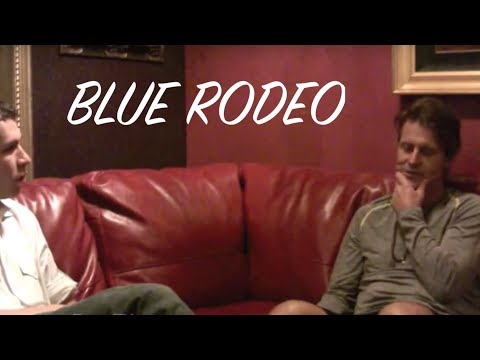
2 clips · 14:30 total
For licensing inquiries please contact reelinintheyears.com. How licensing works →
AUDIOListen
Episode #214 · Blue RodeoJune 2010 · 00:13:20
Episode #415 · Blue Rodeo #2October 2012 · 00:06:33
TRANSCRIPTRead
Show full transcript
0:01Alright, Los Angeles, California, The Mint, one of the most beautiful rooms in LA. I love this place. I've always loved this place. Last one I was here for was Tim Reynolds, the guitar player with Dave Matthews, and I've never smelled so much marijuana in my entire life. It might be a little different tonight with you guys. Yeah, yeah. It's a nice room though, isn't it? Yeah. It's very classy. Yeah. It must be different touring the States for you guys. Well, it's different because we're back to playing clubs instead of the places you play in Canada. But you know what? It's a challenge, and always the transition is a little difficult for us, but it's very good for us as a band, because you have to come back and coordinate all the pieces of that in a much different way than you do on an arena stage or a bigger stage.
0:48So it's actually good for us. And we do different things. We play different songs. How so? What do you mean? We don't feel the setlist a little bit? Yeah, we just don't feel compelled to play as many of the more popular songs. We can pick up songs that we don't play ever. So the Americans get a more thin kind of show? Well, the Americans get a broader palette, yes. Yeah, okay. I mean, we try in Canada to do that too, and certainly they're longer shows in Canada. Right. So Canadians get a lot more of us. But yeah, it's a little broader palette down here. I really never introduced you. It's Jim Cuddy from Blue Rodeo and from the Jim Cuddy Band. You basically tour and write nonstop, I think. It feels like that today. But it's not really that way. I try to do, you know, when Blue Rodeo will take some time off, then I'll do my own thing.
1:38You know, it's fun for me. I like to ban a plan. Well, we have one of the pieces here with us, right? Because Anne Lindsay, who's the violinist in my band, is playing these shows in the States. Oh, really? So I have lent her. Yes, of course. And I get opportunities that Blue Rodeo wouldn't take, opening for people and playing different events that Blue Rodeo probably would turn down. How does a song become a Jim Cuddy song and not a Blue Rodeo song? Just time, just time. Yeah. It's just a question of when I'm ready to do a record, I'll write some songs. I couldn't get myself into that thing where I had songs that I chose for myself. Right. You know, because I've heard a lot of people... Yeah, it would be too weird. And there would be accusations: "What, the song wasn't good enough for Blue Rodeo, but it's good enough for you?" kind of thing.
2:25Well, you could do that all the way around, you know: why keep that song for yourself? It's been almost 30 years since the HiFis and the first record with you and Greg. Does it feel like 30 years? Today. Today? Sure, today, why not? It seems like you're a little more on your own one today. Which is so funny, right? Because we just got down here a couple of days ago. I had a very sick night last night. I think I might have food poisoning. Oh, no. Still, I'm okay now, but last night was just absolutely brutal. It's funny, because, you know, it's one of those phenomenological things: if that had happened to me on the bus, I would have been, why wouldn't it have been on the bus? I would have had to just get thrown off. But it just happened to happen on the night where we're not traveling. So for that reason. But does it seem long? It seems like we've covered a lot of ground,
3:11and it certainly seems like we've done a lot of things, and we've aged. It doesn't... Inevitably, yeah. But then sometimes, you know, if we go out in a bar like this, well, we've been doing this since the very beginning. Right. So, you know, it's like you've run a number of miles on a hamster wheel. How does the songwriting change over the years, with Greg or without Greg, and with your personal experiences? Yeah, we wrote together when we started, because we were trying to create a style. But very quickly we started writing on our own, so we've both established ourselves as independent songwriters. And it's changed because we have a lot more control over that. I think that when we started, establishing a style was enough.
3:57If the song had a particular style, fill in the lyrics, put it out there. And then very quickly that became not okay. And so the songs now are very specific and they're very carefully crafted. So it's quite different now. Are there still topics you're trying to bridge in songwriting? I mean, you've run the gamut on pretty much everything, but are there still topics where you're still waiting for the right one? I guess, you know, we've certainly covered a lot of ground in terms of fractured relationships, and mortality comes up in songs a lot more now. I always liked artists that allowed their songs to be age-specific. You know, I love those last-time Cash songs.
4:43Frightening, but they were great. Yeah. So I think that each age, you know, has its own challenges. And so since we're sort of in our mid-50s, there are gusts of mortality coming towards us. So I think that is a challenge to work into the song. Do they come up consciously when you're writing, or does it just come out and you're like, "Oh, I can't believe I'm talking about that"? Yeah, I think it comes out. I think, you know, once you get an idea for a song and then you start to flesh it out, you're allowing yourself to just reflect whatever's in your mind. And that is the kind of stuff I guess I'm thinking about. I certainly never thought about that when I started. Right. Completely different topic: hockey.
5:28I know it's very near and dear to your heart. What is your, is it the Leafs? Oh, yeah. Yeah. Oh, okay. Yeah, I was born in Toronto, but I didn't live in Toronto until I was a teenager. And that was all through the 60s, when the Leafs were actually really good. So I just developed this incredible feeling about the Leafs, that that was my home that I'd never been allowed to live in. And then I finally moved to Toronto. So my blood is mixed with blue. So it's been a very difficult fandom. Is that where the name for the band comes from? No, I think about it. Blue. No, no, no. No, you know, honestly, I have the same kind of body of history as so many musicians.
6:13I paid no attention to sports when we started playing music. No, I had no interest at all. And it sort of came about, you know, after we started Blue Rodeo. So I'd been doing music for, I don't know, 10 years. And my mother gave me a pair of skates as a Christmas present. "What am I going to do with these? I don't skate here, do I?" I just started asking around and I realized that there were all kinds of musicians that played hockey. So, you know, I braved it and went out again and realized how much I liked it, realized how much more fun it was to play as an adult. And then it just went from there. There's an enormous interlocking psyche between hockey players and musicians. So, you know, we've had incredible opportunities because we've been in a band
7:01and been interested in hockey. Well, the Juno Cup, you've got to play with some of the greats now. Juno Cup was great. We personally helped to turn the Stanley Cup series around. Oh, sure. Yeah. Oh, you hadn't heard? No, I have not. So we went to the morning skate for game three. Oh really? Not skating, but just watching. Yeah. And who's we? I took a couple of members of the band and the crew. Okay. And we had an amazing time, and then we met Mike Richards this summer. So we went down, hugged him. Mm-hmm. And, you know, like, you have to start coming. Yeah. And that turned it around. And look what happened after that, when that game, the next game. The feeling? You just went around, yeah. If you'd just gone around for, how's it going to sound, maybe if you'd just gone around for game seven? No? We brought them back and we thought they were okay to carry on on their own.
7:48Yeah. We should have made the trip. Maybe. Next time. Next time. It's not that easy, you know. Your brother is a Conservative MP or something like that, and you didn't vote for him, is this true? You didn't vote for your own brother, I understand. So first of all, I've never told anybody how I voted. Okay. So that was just somebody assuming. But my brother ran for Conservative MP in my riding. Right. In Jack Layton's riding. And so it was a no-whole problem. That might be where you vote. So Jack won, all? Okay. All right. It doesn't necessarily mean that's where I would have been. But I said the Conservative Party was not traditionally where I put my vote. So, you know, especially because the Conservative Party at that time had no arts policy.
8:36None whatsoever. They had policy statements and they didn't have an arts policy. So probably that would not have been where I would put my support. But I'm not saying I did it. I don't know. I just read something I thought was kind of interesting. Because my mother was so mad at me. Where would you like to see arts funding in Canada? How would you like to, I mean, you were just talking about that. Well, I think what's happened now is, I don't think the amount of money is wrong. I think the amount of money that comes through is right. I think what they have to do is establish permanent funds. I think what they can't do is keep moving it around. You need to have a way for artists of all disciplines to get started, and then you need to have a way for them to let that art travel.
9:23And as long as you have those, recording grants, travel grants, writing grants, painting grants, I think a little bit of money goes a long way. For sure. You know, I know that there's lots of different provinces, I know FACTOR does a lot of things, and there's a lot of provincial money. But I think that the government has to recognize it. Well, okay, so this, I think, ties into it. Greg and I were just part of the Truth and Reconciliation event that happened in Winnipeg. It's the beginning of five years of events which will catalog stories of First Nations, Métis, and Inuit people that went to residential schools in Canada. So they had a music evening at the end of the first day.
10:08The Commission was criticized for making entertainment instead of sticking to the subject. And they said that over the course of time, what they found is that people who suffered severe abuse in the residential schools lose the ability to describe their feelings, lose the ability actually to feel. And the only thing that they found effective in helping people take a few steps towards being able to tell the story was art. Whether they were watching a play, whether they were seeing music, something that related to their situation that could embody their feelings. So I think that in general is what we're talking about, the importance of culture in our country: it is a way of establishing and creating a witness to our culture.
10:58So I think it's important enough for the government to not constantly use it as a bargaining chip to the financial world and say, "Well, we'll cut this off because we obviously have to cut it down." It sounded awful. It's pathetic. Sorry. Yes, that's a better word. I think there's a problem. I'm not sure where Terry McBride sits on the whole intellectual copyright thing. I think he's against it, which I saw him be against.
11:45I think that you cannot continue with a system where people steal music. You can't. How do you stop that though? Well, I think you have to set up revenue gates. Everybody knows how to stop it. Everybody knows how to stop it. You take internet providers and you say, "You have to charge. You're dealing in stolen goods." Why don't we just call it what it is? People are coming to your site and using you to steal. But in Canada we don't have that. We haven't actually established the copyright yet. So that's the first step. But once that's established, then you have to set up gates. And whether it's $10 a month or $20 a month or $100 a year or whatever it is, you have to do it, and then you have to start spreading it out according to what is very easy to figure out when everything's digitized: who sold the most.
12:31I know lots of young bands now. They say, "Oh man, it's great. Put my stuff out there. I can do a gig in Denmark, I can do a gig..." Yeah, it's fantastic. You come back broke. Right? I say to my kids, "You don't buy this kid's music, and I guarantee you he'll not stick with it," because there's no way you can just keep doing music and be broke all the time. You can, but it'll end up being part time. Yes. It's okay when you're 21, 22; it's not quite as okay when you're 32, 35. Yeah. Then you'll get another job. It seems like a total shame. You're going to wipe out a whole, or you're going to shorten the careers of a whole generation of artists, of musicians. It's just stupid. Another thing that's pathetic. It is. You are not, and your music is not. Thanks.
13:17Well, we've got to end it, so thank you very much, Jim.
0:20We have this brand new box set here of a whole bunch of stuff, the remixes, outskirts and odds and ends, which is, I guess, B-sides and rarities of different tunes from over the years, stuff that never got released. We're just going through the first five records. And so, you know, just sort of sit down and listen to everything, from cassettes to our archives. So it's quite an enjoyable process. It must be interesting to listen back to all the songs. You probably don't listen to them too often, I would think, or do you? I think that is the only time we will do it. Yeah, listening to all the cassettes and our rehearsals and stuff, you know, it's all fun, but you have to be in the right frame of mind and willing to truly waste a few days of your life just
1:07listening to rehearsal tapes. Since we're in this room and you guys are working on a new record, what can we hear? What is it sounding like? Where's the record going? Well, we're making it out at Greg's farm. So that's one thing, and that determines a certain sound. It's very woody sounding, you know, we're all in different rooms in his farmhouse. And funny, you know, we came together to make an acoustic record, but we almost immediately abandoned our original plans. So it's pretty rootsy, but it's got a lot of electric touches on it, and
1:55and yet it's a very hard thing to typify. Two new players in the band, and there's that. Well, Colin Cripps: Colin and I started in a band way back when called Crash Vegas, and then about 10 years ago Jim and Colin hooked up on Jim's solo records, and he's been a big contributor to Jim's music over the last few years. And over the most recent years, my ears have been in through a deficit there that can't handle much volume or fatigue, so Colin has taken over playing electric guitar in Blue Rodeo. And that was daunting. It was a daunting year. There were times in the last couple years where I thought it might be over for me, because my ears were in such bad shape.
2:42And I think that played on everybody's consciousness a bit, you know, that we were in sort of a bit of a pickle. But everybody has made this great effort and change to make it work, and all the amps are off stage now, and Colin's playing electric guitar. And at first it seemed very weird, you know, because it was a very different Blue Rodeo, and I think that it's really worked out well. Often with us, the strangest thing, and, you know, one of the reasons why we're still a band, is that when these sort of predicaments are presented to us, we just sort of keep going on, and eventually it falls into place. You know, we're sort of determined and oblivious, and
3:27so that's been a big thing. So Colin is adding great things to this record, you know. And then we have Michael Boguski playing keyboards. He played on half of the last record and he's been touring with us since then, and he's been making great contributions as well. So the band, for some strange reason, has a bit of a new life right now, and I think that's being reflected in the recordings. They sound very fresh. Five quick questions, one-word answers.
4:15Road or studio? Studio. Studio now. That's today. Today. I took your next word. Lennon or McCartney? Gainsbourg. Who's that? Serge Gainsbourg. I just named him right now. Who's that French guy? Okay. Song you've written you're most proud of? Pass. Yeah, it's hard to, you know, you always like the one that you're writing. That's the one that has you immediately, intimately involved. But, you know, there's one that you put... How about this, since we're talking about the box set: what was the favorite to listen back to and be like, "Oh wow, that was a song"?
5:05Were there any? Well, there's so many. There's so many on there that I hadn't heard in such a long time. I'd sort of forgotten about them. You go, "How could you, you know, abandon a song like that?" So I'd say "Fight a Heart." "Fight a Heart," I go, like, that is a classic Blue Rodeo song. Why did we abandon it? I know. Was that a Casino one? Yeah. Yeah, so Pete Anderson would have gone, "I can't get into that. That's got too many wacky keyboards." So are these songs maybe gonna come out live more now that you've revisited them, you're hearing them again and knowing them again? Why not? That's the answer I was looking for. When you hear a song, what usually hits you first: lyrics, melody or rhythm? Uh,
5:51one word, one word: lyrics, melody. And in one word, Blue Rodeo. I think that was your answer last time, just laughter. Yeah, that's impossible. Old. Old for that. Awesome. Thanks, guys.
ABOUTThe archive
This interview is part of the Matt Schichter Interviews archive: more than 700 conversations with musicians, actors and filmmakers recorded between 2003 and 2014, beginning with The BackStage Pass, one of the first podcasts (2003). The archive also became Matt's short documentary Lennon or McCartney. Matt Schichter is now a Glasgow-based producer, line producer and music documentary director: he directed CFNY: The Spirit of Radio (PBS, TVO) and line produced Faith (TIFF and Rome 2026). His films → · UK film producer and line producer → · More about Matt →
Listen to the full archive on Apple Podcasts or Spotify.