Lennon or McCartney? KT Tunstall’s answer: Lennon. Watch the moment. See every artist’s answer. Take the quiz.
SONGSWhat KT Tunstall said about the songs
“Black Horse and the Cherry Tree”
KT Tunstall explained that the song was partly about the fear she felt signing her first record deal.
“it was partly about going through the experience of signing a record deal... I found it one of the most terrifying, soul-questioning moments for me, where I was just going, am I signing my freedom away here?... so it's really a song about a Robert Johnson-esque story of being at a crossroads”
The song wasn't even recorded when KT Tunstall played it on Later... with Jools Holland, so early copies of her album used the TV audio.
“the first 10,000 copies of my album have the audio from the TV show, because we had no recording of the song. And then we ended up recording it in a day, just me and the drummer, and that was it.”
“Hold On”
KT Tunstall said the beat on this song came from the dancehall scene in Harlesden, the London neighbourhood where she was living.
“'Hold On' is the point where you can hear that I'm starting to get really interested in beats... you'll walk around Harlesden, where I was living in London, and everywhere the windows are down... that's the beat, the dancehall beat, everywhere. And I was like, God, I love that beat. And so, yeah, I stole it.”
“Fade Like a Shadow”
KT Tunstall described this upbeat single as a scathing song about someone who had got under her skin.
“you have what sounds like a very upbeat, happy, positive song, and it's actually quite bitchy... I'd met someone who, I don't name and shame... who had really got under my skin, and they kind of haunted me for a while... and so I ended up kind of exorcising it in a song.”
“Invisible Empire”
KT Tunstall explained that the intro sound on the album opener is a real Mellotron at Wavelab Studio in Tucson.
“It's actually a Mellotron, which is a beautiful, very old instrument. And one of the few real ones is at Wavelab Studio in Tucson... It was used in a lot of old kids' animation in the 70s in Britain, so it's a very nostalgic sound for me.”
“The Scarlet Tulip”
KT Tunstall said this finger-picked song felt like something she remembered rather than wrote.
“it just came together with the melody, the lyrics of that... it was just one of those songs where I felt like I was remembering it rather than actually coming up with it. It just felt very old and very familiar, and I'm very proud of that one.”
VIDEOWatch
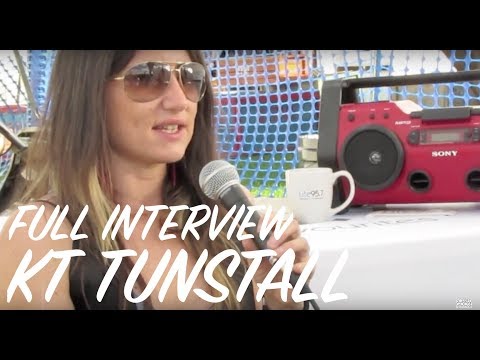
3 clips · 34:01 total
For licensing inquiries please contact reelinintheyears.com. How licensing works →
AUDIOListen
Episode #315 · KT TunstallOctober 2011 · 00:19:07
Episode #606 · KT Tunstall #2October 2013 · 00:14:10
TRANSCRIPTRead
Show full transcript
0:03Well, hello everyone, thanks for coming by. This is cool. I didn't expect to have a crowd. It's nice. Hi. This is KT Tunstall. Hello. Hello, how are you? I'm very well, thank you. Yeah. How long have you been in our fair country? I've been here since about half past nine this morning. Oh, this morning. Well, no, that's not true. I was in Canada... Yes, I played the Regina Folk Festival last night. How was that? How does that compare to this one? Fantastic. Well, I don't know yet. I just got here. So this is obviously quite a lot bigger. Yeah, and it's definitely got that kind of massive festival vibe, and I'm seeing people dressed up and it's all looking good. It's all very promising. What's your favorite, since we're at festivals and you've been at festivals for quite a while now, what's your favorite festival memory? My favorite festival memory is possibly
0:49when I was running along a very dirty track, I can't even remember, maybe T in the Park, which is a festival in Scotland, and Wayne Coyne from the Flaming Lips, it looked like he'd stolen a golf cart, and he was kind of bombing along this track, and I said, "Wayne Coyne, you rule!" And he stopped his golf cart and gave me a big hug. That was very cool. That was very cool. So you've got two sets today, 5:40, Stage 5, Jeremy Fisher, a few other people. What, you know, what's going on? No one seems to know what the studs are either. I was hoping someone was gonna tell me. I'm taking my guitar, that's all I know. Yeah, so is it just you and the loop pedals today? Do you have your band? Just myself. It's just me and guitar on stage. I have two guys from my band, so it's just a three-piece, a stripped-down, quite rocky show. And I do have my loop pedal with me tonight. So yeah. [inaudible] What do you call it?
1:36A one-woman orchestra? Exactly. I want to go back, though. There was no music in your house as a kid. Is this true? You did not listen to music as a kid? My folks weren't big music fans. They didn't listen to music. So what got you into it, then? It was more about playing. I was really into playing instruments, and so when I did my music class at school, my music teacher was a piano player, and I'd just watch how she was playing and I'd really want to learn how to play. So when I was about four, I asked my parents for a piano, and they were pretty bummed that I'd chosen the biggest instrument you could choose. And so yeah, I started learning classical piano, and then really just got into learning anything I could get my hands on, just to up myself, and ended up teaching myself guitar and singing. I've not had lessons in those things.
2:23It was just finding a way of writing, and it felt natural to play those things. Do you still play piano? Yeah, I do, actually. You don't bring it on live, though. No, I've done it. I did a solo tour of North America, and I took a keyboard there, but I'm just not made to play piano, because you have to be so precise when you play piano, and I'm a messy musician. I'm just all about vibe and rhythm. So when it comes to timing, I know with the pedal, timing is a big thing. I put down a lot of my success to doing tap dancing when I was a kid, and learning some good old coordination was a good thing. So where did the loop pedal idea come from? Because that's pretty innovative, especially the way you do it. Well, it was really because I'd recorded that first album, Eye to the Telescope,
3:11and I'd been playing open mic nights and playing on the street and doing a whole load of, you know, solo stuff, and then got my record deal and made a record, and it kind of sounded like a band, even though it wasn't really. It was people coming in and playing, and it wasn't exactly five of us in a room being recorded. Like, I played quite a few of the things myself. And so when it came to actually going out and playing that record for people, I just couldn't face going out and just being girl with guitar. There were so many girls just with guitars, and I really needed the rhythm. The rhythm had become such an important part of what I did. So a friend had, well, it was really just a guitar loop pedal, and I'd seen a couple of people, a great guy called Jim White,
3:58you know, I don't know if you know him, an American singer-songwriter. He would loop his guitars. And I saw another guy who I'm pretty sure is Canadian, actually. He's called Son of Dave. Oh, yeah. I think he used to... And he would beatbox and play harmonica and kind of rap the blues over his voice. And I thought to myself, well, surely you can put the guitar and the voice into this thing. So my friend and I kind of set to working out how to do that, and it was when I started beating up my guitar that I realized that I could kind of use it as a drum machine, and that kind of kicked off. How does it work for the new songs? The new songs are a lot more electronic than the folky stuff that you used to do. Yeah, there's more electronic in the new stuff, and I've incorporated another bit of gadgetry, which is actually a more electronic pedal, which I play on my old song "Other Side of the World,"
4:45I've kind of revamped it. And so I've just introduced some electronic beats as well as the analog stuff that I'm recording. So you decided to make it, what do you call it, nature techno or something? Nature techno. "Nature techno record" doesn't really describe the whole record. It was more a sort of target for me to remember where I was trying to get to with the sound, the kind of feel of the record, which is sort of a mixture between my favorite electronic dance music and Eddie Cochran. Eddie Cochran? Yeah, like 12-bar blues, Eddie Cochran. Yeah. But, you know, you listen to "C'mon Everybody" and "Summertime Blues," and they make me feel pretty similar to really great dance tunes, like Leftfield and the Chemical Brothers, that make me want to dance, and they've got a pulse, and they just make you present when you listen to that kind of music. And
5:33that's what I wanted to kind of get through. It wasn't really about sounding like a dance record. It was more about playing instruments the way that I play them to sound like that. So it's a lot of natural instruments making the sound of a conventional dance record. And you certainly went to the right place to record it. You did. Yeah. Like, this is where the Berlin Wall was, is that true, the studio? Yeah, Hansa. The studio where I recorded Tiger Suit was called Hansa by the Wall. And Bowie recorded Heroes there, and Iggy Pop recorded, U2 did Achtung Baby, Depeche Mode mixed their first records there. On the roof, and the Berlin Wall was still standing at that stage, it was in the 80s, and by all accounts Depeche Mode went up on the roof, took a PA system, and
6:23pointed the speakers at East Germany, because the studio's in West Germany, so that the East German border patrol could hear their records. And they were sort of all... So it's a really amazing place. But of course Berlin and Germany are also intrinsic to the electronic dance movement. I mean, it's kind of the birthplace of, well, Kraftwerk, but a lot of very important dance music. And Berlin's great. I'd never really been before, and it's got such an energy to it. It made, for me, because I live in London now, it made London feel quite self-conscious, like we're worrying about what other people think. And there's more artists per square mile in Berlin than any other city in the world, apparently, and it's very cheap to live there.
7:09But also there's just a real lack of self-consciousness. People are just getting on with doing what they want to do and not worrying about what people think of them. So that's a really healthy environment, for sure. Where do you think the next record's gonna go? I mean, it's a natural progression for me. I'm very excited about the next record, actually. Do you write on the road? Are you writing right now? A little. I've started to. I never have in the past, but I've had a new song stuck in my head all day today. Are we gonna hear it tonight? No, my first verse is wrong. I've got to work it out. But yeah, what I'm gonna do is, Jim Abbiss, who I worked with on this last record, he also did the Arctic Monkeys, he did Adele's first record, he's worked with a bunch of really... Editors as well, if you're... Yeah, he's worked with some really fantastic
7:57original new acts. And so when I went into the studio with him, I just thought, you know, this is a guy who can sort of listen to what makes you different from other people and really put the microscope on that, rather than trying to make you fit in, which I really liked about him. But in the process of it, we just had such a laugh, and we were coming up with all these kind of beds to songs that were just pumping dance tracks, and they were sort of going a little too far. So we've decided that in September we're gonna go back to the room that we started working in, which is Trevor Horn's studio in London, where George Michael recorded Faith. Yes. Which we bonded over, loving this song. And we're gonna make a proper dance record, not under my name. We'll do it under a side project, and we're just gonna go in and laugh for three weeks and
8:46make a dance record. And then I'll start on my next solo album, which, my aim with the next solo record is just to, I want it to be about just crying. I want it to be about either happy crying or sad crying. I just want it to be emotional and really very lo-fi and raw, and quite DIY is what I'm looking at. Wow. Do you still have a label, though? Yeah, I'm still on EMI. And the EP was just you, though, right? The EP was, yeah. That was the first sort of very autonomous project that I did, and I did it with my husband. He's the drummer in the band, and we recorded it in our solar-powered studio in England, and it's the first thing we've sort of produced in that way.
9:32And it was so liberating to go, God, I can write a song, we can go in the studio at any time of day, record the song, and then stick it out, put it on vinyl. It's just so great. And I think that with the way that music's going, and the way that it's struggling under the weight of the internet changing how people get their music, I think that the way that you make music and the way that you deliver the music is now incredibly important to fans. You know, not to just do it a normal way, slap it on a CD, have a big ad campaign. It's not very exciting anymore. You want a story, and you want to craft something that people are really invested in, and they think, wow, that's a really great story, and I want to be part of it by getting hold of that. Do you need a full record, then, or can you just put out songs? I mean, this is the thing. This is how it's changing so much. I think that people are,
10:22musicians are really getting to a place where they will release almost immediately. I'm a massive advocate of the album, and I think I'll probably always make albums. But you can't force people to buy the whole album. But one thing I would say is that, you know, many, many of my fans who come up and say hi tell me what their favorite song is, and it's so seldom a single. It's usually an album track, and you just think, well, you know, you may well not have heard that track if you hadn't clicked on the whole album, rather than just pick the songs that you hear on the radio or whatever. So I still think an album's a really important way of delivering a whole artwork of ideas, rather than just, you know, the catchy stuff. Because the catchy stuff is great, but it's not necessarily the best.
11:12Do you try and write singles? Do you know you're writing a single when you're writing a song? No, you don't set out. I don't set out to write it. But then sometimes I'll come up with a riff, and like this new song that's stuck in my head, I was like, okay, that's good. That's good. That's good. It's good. It's good. And, you know, it might be. But nobody knows. I mean, you talk to the most successful record dude, and he doesn't know. Nobody knows. There's not really a formula for making something successful. But certainly, you know, my seven-minute talking songs with no singing in the background probably aren't gonna be a single. Well, we're a place of singles. Oh, it's a radio station, obviously.
11:57Yeah. So when this airs on Monday, what we do on the website is we have three songs, people can vote on them. So I thought maybe we'd get you to do a little Storytellers about those three songs. Yeah. And cut in whichever one wins. So let's start with "Black Horse," since it was the big, huge worldwide hit. Well, "Black Horse" is a pretty bizarre story, because I recorded Eye to the Telescope and "Black Horse" wasn't written, and the album was being pressed, you know, everything was going fine. And then Jools Holland, who has this fantastic music show in the UK, his scouts had come around to check out one of my rehearsals to see if they liked what I was doing. And my record label boss said, "Play that new one, the 'Woo-hoo' one, the 'Woo-hoo' song." And I was like,
12:47but what's the point of that, because it's not on my record? You know, I was thinking I'll save this for the next record. And he said, well, don't worry about it, just play it and see what happens. So I played it, feeling quite stressed out that, you know, this is not on my album and it's just a brand new song. And so a few weeks went by, and then I got this phone call. I was on tour playing in my friend's band, and they said that Nas the rapper had pulled out of the show because his father was sick, and would I like to take the spot? You know, I'm completely unknown, and my album hasn't been released yet, and so of course I say yes. And then again my record label's like, "Play that, play the new one." I was like, you're mental. This is not on the record. We have no recording of this song. So, don't worry about it,
13:34just play it, just play it. And so I play the song, and then it kind of goes through the roof, and it becomes this sort of sensation, and everybody's into it. And so the first 10,000 copies of my album have the audio from the TV show, because we had no recording of the song. And then we ended up recording it in a day, just me and the drummer, and that was it. But really, it was a song about, it was partly about going through the experience of signing a record deal. And as a musician, you think that it's gonna be amazing, and you want to drink champagne and party all night, and it's, you know, it's incredible. And actually I found it one of the most terrifying, soul-questioning moments for me, where I was just going, am I signing my freedom away here? What am I doing? I don't know these people. Are they gonna want to change me? And so it's really a song about a
14:28Robert Johnson-esque story of being at a crossroads, and you feel that one way is a light way and one way is a dark way, and not really feeling that one is right or wrong, but just having to make a decision where to go. Well, seven years later, do you feel like you sold your soul? No, I don't feel like I sold my soul, but I've definitely battled. I've been in battle, you know. I don't think that, really, you know, the agendas of a record label and of an artist will ever be the same. So you're always gonna fight. I think there's really something wrong if you don't fight with your label, because they're trying to sell you, and they're trying to make you make stuff that sells. And that's not your priority as an artist.
15:13So, you know, you pick your battles and you have some good fights, and you end up putting out what you want to put out, and you get there in the end. Let's move on to the next record, Drastic Fantastic, and "Hold On." Well, "Hold On" was really, if you listen to the first album and then you listen to the second album, Drastic Fantastic, I think "Hold On" is the point where you can hear that I'm starting to get really interested in beats. And I had moved to northwest London, and it's an area of London where there's a huge dancehall scene. There's a lot of Jamaican, a lot of West Indian people living there, and they've kind of got their own very microcosmic music scene. So these gigs will happen that only happen in this area. But you'll walk around Harlesden, where I was living in London, and everywhere the windows are down and it's just going,
16:08everywhere, every window, that's the beat, the dancehall beat, everywhere. And I was like, God, I love that beat. And so, yeah, I stole it. All right. Yeah, it's good fun. "Fade Like a Shadow," the new single. "Fade Like a Shadow" is one of my favorite tricks with a song, where you have what sounds like a very upbeat, happy, positive song, and it's actually quite bitchy. It's quite a nasty... not nasty. It's just quite a scathing song. And what had happened was that I'd met someone who, I don't name and shame, it doesn't seem fair,
16:53who had really got under my skin, and they kind of haunted me for a while after I'd met them, and I just couldn't shake this feeling. It's just meeting someone who doesn't make you feel good about yourself, and you feel like they're doing it deliberately. And so I was really struggling to kind of shake this feeling of being haunted, and so I ended up kind of exorcising it in a song. Nice. And so, yeah, it's quite a needly number, but it definitely helped me get past whatever it was. Cool. I know you've got to go because you're on stage soon, so we do something called five questions. Five quick questions, one-word answers. Road or studio? Oh, I can't. I would have said road straight away about two years ago, and now I have my own studio. I can't answer that question.
17:44I'm loving studio, too. Lennon or McCartney? Lennon. Sorry, Paul. That's okay. What moves you most: lyrics, melody or rhythm? It's so hard. That's like saying you're gonna choose your brain, your heart or your soul. I would say at the moment rhythm, but they're equal powers in the world. Song you've written you're most proud of? Ha. There's a song, it changes, because you're always just proudest of the most recent thing that you've done, but there's a song that I'll play tonight which is a part of a new collection of
18:34very acoustic, finger-picked songs, and it's called "The Scarlet Tulip." And it just came together with the melody, the lyrics of that. The rhythm isn't a big part of it, actually, but it was just one of those songs where I felt like I was remembering it rather than actually coming up with it. It just felt very old and very familiar, and I'm very proud of that one. Cool. And in one word, KT Tunstall? Hi. It's good. I'll take it. Thank you, KT Tunstall. Thank you.
0:06Hi, I'm KT Tunstall, and you're watching MSN Exclusives. So this video, that's that difference. It's like Lord of the Rings. You've got swords and armor and horses. I got put into Game of Thrones. I don't take my clothes off, though.
0:51That's the more present reference. I don't do the, like, oops, my dress has fallen off Game of Thrones. I do the... Khaleesi. I do the sword fighting. But there's some funny stories behind that video. Well, that's what we're here for. We're here for funny stories with KT Tunstall. Well, it's the "Invisible Empire" video. And first of all, the guy who is the sword-fighting knight in the video, the guy who was meant to do it phoned up 10 minutes before he was meant to be there and told us that he'd fallen off his motorbike on the motorway, and he was okay, and he was going to be there in like 10 minutes. He didn't show up for two hours. And so when you're shooting a music video in one day, you can't really have the guy who's in the video not turning up.
1:38And so we didn't really know what to do. And it was in this beautiful forest in Kent, in England, south of London. And then there's three guys working in this forest, three foresters, if you will. And one of them, Julian, has been doing medieval sword fighting for 12 years, is the right size for the armor, and is allowed the day off. And so he basically takes the day off and becomes the knight in the video, and teaches me how to do it, because I'd never done it before. It's a new skill. Yeah, so he was just this complete angel sent by the god of Game of Thrones to save the day. And then secondly, I mean, I am a horse rider, but I've not done a lot. Major confidence over technique.
2:25And the director had just gone to the beach a few days before and just found someone with a horse and just said, hey, do you mind if we use your horse in a video? And they're like, yeah, sure. And so the horse was kind of mental. It was a lovely, lovely horse, quite old actually, but incredibly excited to be on the beach and did not want to stand still. And so while they're pulling focus and getting everything ready, I'm having to run this massive horse all around the beach, and there's people everywhere. You can't see them in the video. There's all these people having their picnics, and it was like driving a sports car. It's like, if you don't turn the wheel, it's just going to go straight into someone's picnic. And children. And it was pretty intense.
3:10And so I was kind of the whole time going, "Stop, stop!" And then when the camera came on, I'd just be like, poise, poise, stop! Consummate professional. It was a very sore bum for about a week. I can imagine. Yeah, it was full-on. "Invisible Empire" opens the record. It's a beautiful opening, and even the little, I don't know what it is, at the intro of that song. It's actually a Mellotron, which is a beautiful, very old instrument. And one of the few real ones is at Wavelab Studio in Tucson, because it's very common to use it as a plugin, like just an electronic thing copying it. But you feed, it's rolls of card with holes in, and it reads like an old organ.
3:55Or maybe it's discs. It might be metal discs, actually. But it's kind of samples of flutes and samples of clarinets, and it just sounds fantastic. It was used in a lot of old kids' animation in the 70s in Britain, so it's a very nostalgic sound for me. It almost bridges it. What do you call it? Nature techno, from the last record, I think is what you told me. It almost kind of bridges that into what this is. Folktronica. Folktronica. I like that. Yeah. Next record: Folktronica. Did the songs just lend themselves to that kind of arrangement? Or was it purposefully going in and saying, I don't want to add all the stuff over it? It was a very easy record. This is definitely the easiest album I've ever made, and it just came so quickly. The first half of the record, I wrote, I met Howe Gelb, front guy of Giant Sand, maverick, punk spirit,
4:43genius musician, in February of last year. And he said, come out to Tucson and do some recording. We didn't say let's make an album. He just said, come out and record and let's have some fun. And I really needed that kind of experimental approach, where it wasn't labeled before we did anything. And in the February and March before going to Tucson, I wrote like nine songs, which was a lot for me. And six of those were the first half of the record. And I heard you wrote basically everything at the same time, kind of scribbling back and forth. So did lyrics lend themselves from one song, and you'd say, no, that fits better here? No. I wrote them all in tandem, which I don't usually do. I'll usually stick to one song and finish it. But these all were, I mean, it was like that crazy game at the old-school fair,
5:30where the horses are going and you're cranking and they're kind of all coming in. So I kept getting quite stressed out that I wasn't finishing anything. And then they all finished at the same time, and somehow they stayed completely separate entities from one another. There's definitely similarities, I think, stylistically between the songs, but in terms of their content, they stayed pretty hermetically sealed. I hear it was really hot when you were making this record, like sweltering heat. Does that loopiness add to the creativity? Well, I just couldn't go outside. It's just too dangerous for a Scottish person in Arizona. It's really a threatening temperature. But it was totally bearable when I was there in April.
6:17And I took a drive now and then in the evening, which was really cool. And then when I went back in November, it was cooler, and my very good friend Jane Mingay, a great photojournalist, who decided to do all the photos for my record, her and I just took her 1960s Barracuda and drove into the desert and had a great time just getting all the imagery. So it really sinks into that landscape. It's the first time, with the imagery, it's the first time it's not your face. It's still you on the cover, but it's the opposite side. Yeah, I think it's probably significant. Is it? Yeah, I think so. It came very easily, actually, because it was just so striking with the landscape. It just spoke about what the record was like.
7:02And it was the first time as well in my career where I really knew what I wanted to wear. I'd never engaged very much with image, and I just sort of threw on a rock uniform, got some leather trousers and a cool t-shirt or whatever. But I'd never had a vision for how I wanted to look when I made an album or played. I think a lot of that was actually deliberately shying away from it, because, A, I'm not madly interested in fashion. I like nice clothes. I like well-designed stuff, but I'm not crazy about getting involved with it. But really, I think the main thing was that as a female artist, I was just really paranoid about having that double judgment
7:48of being a female musician, that there's so much emphasis on how you look. And I just really didn't want to engage with that. I just wanted to be a musician. I really didn't want the attention to be on... I didn't want to be in magazines. I didn't want to have people comment on what I was wearing. So I just got on with it, really, and wore what I liked. But this album's been very different, because I had this really strong image of wearing a suit and wearing this hat that I'd found in Italy, and kind of assuming more of a character, really. Did you have that going into songwriting, or did the songwriting speak to that imagery? The wearing a suit thing had already happened. I kind of had this feeling that I just wanted to dress classy and more formal.
8:34But formal is really the wrong word, because I look at someone like Nick Cave wearing a suit, and that's what I mean. It's actually just a very classic, powerful image. Do you do that on stage too? That's the character for this whole... And it's me. That's a different way of doing a run. It is me. It's not an alter ego in any way, but it's definitely part of me. Speaking of being on tour, and talking about the music as opposed to the fashion part of it. Just you? Just me. Just you. Solo tour. And we're starting the tour today. I'm always excited about the first gig. It's always slightly nerve-wracking, because I don't think about it until about half an hour before. So the set list, whatever you feel like? I've learned all the new stuff, but I've forgotten all the old stuff. My brain tends to delete stuff when it doesn't need it, which is annoying sometimes.
9:23How will the old stuff play in... They must have been written on acoustic guitars, right? Yeah, exactly. I mean, I think my last record, which was very electronic-inspired and made in Berlin, and really kind of an adventure in sonics rather than songwriting, there's still a few songs on that that I can easily sit and play, but maybe less so with that record. But in general, all the stuff I write, you can sit and play. Cool. So it's quite nice to deliver them very straight back. When you saw my tweet yesterday, people did respond, ask questions. Oh, really? It is. It doesn't happen every time, but we got a couple of them. Someone asked one, and I replied to her and I said, I will be the answer to that. I hope it's not one of them that I choose. Well, see, I didn't tell her the answer. If you don't ask it, then I'll answer it for you. Okay, cool. It's post-apocalyptic UK. Okay.
10:08And is this the one? No. Okay. And you have to burn all your books and guitars to keep warm, except one of each. Book and a guitar, what would they be? Book and a guitar. Well, guitar, I would keep my 1959 Gibson acoustic. It would have been my 1975 Gretsch Falcon, but it needs an amp and a plug. Right. The apocalypse is going to ruin all the plugs. No power. So I'm going to take my new, very old 1959 Gibson acoustic parlor guitar, which is so beautiful to play. Parlor, the little guy. Yeah, it's half size, and suits this record down to a T, but it's like the guitar I've been looking for forever. Is it the guitar that's all over this record? No. I just bought, I found it a couple of months ago. Okay. And I saw it, and it was a proper, there you are,
10:53I've been looking for you. So it's been really nice to find him. And one book. And one book. Yeah. That's really hard. What would I want to read over and over again? That's the thing that I always find difficult with this question. It's just like, what would you get more and more and more out of? You have to take something quite big. You have a lot of time on your hands. Yeah, exactly. I might actually take A Brief History of Time by Stephen Hawking and try and get to grips with it. Okay. That kind of goes to your tweet the other day with the white blood cells and the sun. Yeah. Blew my mind. Well, I'll just explain that, basically. Yeah. Yeah. It was like, what is she talking about? You know, the white blood cells and the sun. Don't worry about it. If the sun was the size of a white blood cell, the Milky Way would be the size of the United
11:38States of America. Okay. Other Twitter question. Very similar, same girl, but I like these ones. You got what? Very apocalyptic, this one. If you got washed up on an island with an old record player and one vinyl. That's the one. I think she said a Dansette. Dansette record player. Dansette record player. Yes. Okay. Django Reinhardt. It sounds amazing on an old Dansette. And I had one. Well, that's why she mentioned these specific record players. An old Dansette record player. It's one of the ones where the speaker is built in, the old box from the 50s, and you put the lid up, and then when you close it, it creates the sound properly. But new records sound foul on those things. You just don't get any width and depth of sonics.
12:26But Django Reinhardt on one of those is like a time machine. You just feel like you're in a good place at a good time. We don't have much time, but just the vinyl idea, and I know you kind of crafted this record with the idea of two. Did you ever think about releasing it separately, as two EPs or whatever you want? No, it was always going to be one. It was always going to be one record, and it was very much inspired by the A and B side of a vinyl. So it was lovely. So it had to be. I held the vinyl in my hands. It was great to know that it reached its true perfection. So we do something called five questions. Five quick questions, one-word answers. One word. One word. Ten years today we've been doing the same five questions. Road or studio? Studio. Used to be road.
13:11Nice. Studio. Lennon or McCartney? Lennon. When you hear a song, what hits you first: lyrics, melody or rhythm? Melody. If someone's never heard KT Tunstall before, what song do they start with? I don't know the answer to that one. Personally, what would I choose? That's a really hard question. I know, it's my new favorite one. I would say you probably have to listen to "Black Horse and the Cherry Tree," because it's just my little package. I don't like that. A live version or the recorded version? A live version. Jools Holland? With "Seven Nation Army" in the middle of it. You can find it on YouTube. In one word, KT Tunstall?
13:59Me. That was a quick answer. I like that. That's good.
ABOUTThe archive
This interview is part of the Matt Schichter Interviews archive: more than 700 conversations with musicians, actors and filmmakers recorded between 2003 and 2014, beginning with The BackStage Pass, one of the first podcasts (2003). The archive also became Matt's short documentary Lennon or McCartney. Matt Schichter is now a Glasgow-based producer, line producer and music documentary director: he directed CFNY: The Spirit of Radio (PBS, TVO) and line produced Faith (TIFF and Rome 2026). His films → · UK film producer and line producer → · More about Matt →
Listen to the full archive on Apple Podcasts or Spotify.