VIDEOWatch
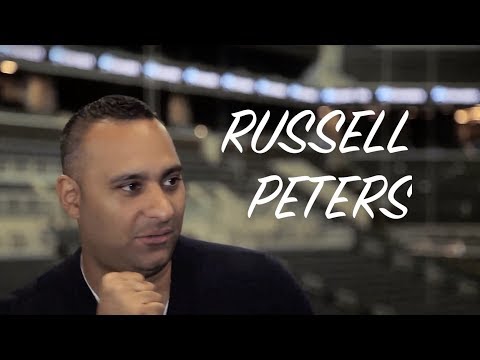
2 clips · 24:58 total
For licensing inquiries please contact reelinintheyears.com. How licensing works →
AUDIOListen
Episode #423 · Russell PetersNovember 2012 · 00:12:42
TRANSCRIPTRead
Show full transcript
0:08Russell, Matt with MSN.ca. Russell Peters, man, how you doing? Hey, I just washed my hands. Thank you, I appreciate it. A little clammy. A little clammy. So this is where you'll be Saturday. This is it. This is the big time, kids. Yeah, it's a pretty impressive venue, though, isn't it? It is. It's very industrial looking. I'm surprised by the black and gray. Well, that'll change when you get in here with your big setup and everything. Yeah, then it'll be brown, black and gray. So there's a crew around you. I'll start with this, because there's been a crew shooting you since I got here. I recently signed a deal with Netflix where they get exclusive rights to my next special. So as opposed to going to DVD first and then me selling it to networks,
0:57it's going directly to Netflix, and they thought it would be interesting to document me leading up to the special, to the recording of the special. So it's kind of like a 24/7 kind of thing, where they basically follow me in training until I get to the fight. In training. So talk about training, talk about crafting an act. Where does an act like this start? Well, the crummy part is they weren't there for the beginning of it, like in January when I first... well, November, I really just first started getting back on stage with no act. With no act. So, you know, one year ago exactly I had zero. Okay. And now we've got an hour and a half. So where does it start? You go to the Laugh Factory in LA, or you play... Are you doing stuff for friends? Like, how do you know? I think the first time back on stage was... where was it? It was in Arizona.
1:44It was in Phoenix, at Stand Up Live, and I literally had nothing. So you're just riffing on the crowd? All I could do is riff on the crowd. And taking stuff from what they say? Yeah. Things that people would say, things that I would think of on the spot, or what have you. And then I would take that, and then I came to New York and did Caroline's for a week. You know, again, just little things. No, I was headlining the week. It was me meandering through, you know, going into survival mode. You know, stand-up is like boxing. So, you know, when you're in a situation that's unfamiliar or dangerous for you, you immediately go into survival mode, and you can throw a dangerous right hand, but it's not guaranteed. I mean, so it's that situation. And now, you know, when I started touring with the show, it was in March.
2:33And again, it was still so new. The act was only three months old at that point, and it wasn't polished yet, even. But now it's in a good place. It's very nice. Quite happy with it right now. Right. And so this will be like the big test run. The DVD, you said you're gonna shoot it in... We're gonna shoot the DVD in Australia in March. In Australia. I like how you're going around the world to shoot these. Yeah, well, that's the thing. I mean, you know, anybody can just go to one place and shoot it there every time, but what's the point of that? Well, I noticed with the London, the O2 gig, a lot of it is British humor. You're catering to the crowd a lot. Yeah, especially on that one. And, you know, that was actually my least favorite effort that I've put out. Why? I don't know. I don't think I was in a... mentally, I wasn't in a good place. I was very distracted by life. Sure. And
3:19later, that's... yeah. And now I'm back to being me, so the act is right where I want it, and I'm really happy with it, and I can take pieces of it out and do it in different areas. And, you know, the last one, I don't feel there was any one bit that I could be like, I could do this somewhere. The audience was very... they were great, but they were not as much of a mixed demographic as I usually like performing for. And that's because England has a huge South Asian population, and, you know, they came to represent for me. I'm not mad at that at all, but as a comic I should have been better than... I should have been able to go in different directions with them, which I didn't do, and that's my fault.
4:06So now I'm back, and I'm doing the act that I feel like doing. Your fault? Because from what I read and gather, it's very improv. You don't really know... there's a lot of them, you know, and it comes across that way too. It's not scripted. So I wonder about Australia. Are you gonna try and tailor things for them, or is that just... Australia's always been amazing. The audiences there, like, there's been... I did two and a half hours one night in Australia. But the funny thing is, I did two and a half hours, it was a solid two and a half hours, like they were laughing from beginning to end. And here's the ironic part: they never gave me a standing ovation. I was so mad about that. I was like, I just did two and a half hours and not one of you could get up and go... But I don't think culturally they do that. But it's one of those things where it's like, nothing? Not one person stood up?
4:59But you know, you have great sets in Australia. Yeah, well, and great sets in America. Two things are really... Everywhere. Yeah, especially to tie it back to the show. Yeah, absolutely. I see what you know. Yeah. And, you know, New York is that one city for me in America where I feel like I'd tape every DVD, and it would be, you know, the main... I taped Red, White and Brown at Madison Square Garden. That was one of my more memorable sets. And New York is one of those cities that inspires you to do well, you know. Every time you're in New York and you're performing, I always hear in my head, "If I can make it there..." I'm like, well, it's up to you, New York. My opening act will be my buddy Reuben Paul. Reuben Paul, for those who don't know? He's a comedian friend of mine from LA. He's a
5:45[inaudible]. Whoa. He's one of my dear friends who... he's actually the only person I've ever met in my 23 years of doing stand-up who can help me get my set together. Interesting. What do you mean by that? That's interesting. I don't know... well, no, he'd be like, have you thought about moving this to the... It isn't so much material, he just kind of watches what I do and goes, why don't you put this here and then that there, and I think it'll flow better. Because sometimes you just get caught up in it, and obviously you get a better perspective from the outside. And so he's always made me make these little shifts, like put this here and put that there, and it always made it better. It's like a track listing for a band: this song is better here during a set. Yeah, he's almost like the...
6:31He's a comic, a very, very funny comic too, but he's great at producing what I do. The Rick Rubin of comedy. He is. He's my Rick Rubin. Rick Reuben Paul, apparently. I talked to a lot of songwriters who say that getting the breakup sentiments out is cathartic and therapeutic for them. Is it the same for you? I mean, highly publicized divorce, right? So yeah, I assume it's gonna show up in the act. The divorce is in there, the baby is in there. Yeah, well, I almost think comedians, we almost self-sabotage our personal life for this. Yeah. I'm not saying it's done knowingly, but there's probably a subconscious thing that makes us do that, because if a comedian's happy, that's the worst place he could be. It's sort of an ironic thing. Yeah. The happier we are,
7:19the worse our show will be, because what the hell are we so happy about? We're not here to spread joy. You are. Yeah, we're spreading joy through our misery. It's an interesting position. It is an interesting position, because the more things you have going wrong in your personal life, the more relatable you are to everyone else, because everybody else has these problems. And, you know, if all you do is get up and talk about how successful you are and how great life is, nobody wants to hear it. I don't want to hear it. Is it easy for you to write those bits? I think when it happens naturally, it's easy to talk about, and I'm not a guy who runs away from what's happening. I don't hide behind the character. I am me. So it's easy for me, and it actually helps me a lot, you know, when I say it out loud.
8:05You don't write, though, from what I... I don't physically write down anything. Never written a bit? See, I used to write my bits down. Okay. In fact, I used to write it out word for word when I first got into comedy. I would write down, like, if I said "um," I would write "um." Like, I would literally write it out word for word, sound for sound. And then I don't know if I just got lazy... I got lazy. I'm acting like I don't know. If I got natural... if it's not, though. At the same time... Yeah, I mean, for me, I think if it was written down, then I would probably say it the exact same way. And that's something I probably discovered when I would write it down like that: I would do it that same way every time, and then there's no room for improvement or word economizing or anything. So it makes it more flexible and easier to adjust to the crowd that's in front of you. Absolutely.
8:56I can't remember what interview I was watching, but you were talking about almost needing to do ethnic jokes because that's your thing, people come to see them. Right. So you have to do it. Is there a pressure for you to add that? Is that something you think about, or do those jokes just come to you and you're just like, well... Well, they come to me, number one. They come to me, and then there is a bit of a pressure to maintain that flavor of comedy, in that, you know, your fans are coming to hear a specific style of comedy. And I don't need to make my whole act about that anymore, but it needs to be in there. Anymore? It used to be? Well, I never felt like I had to. It's just what I did. That's what, you know, as a comic, as an artist, you grow, and you've got to keep going too. I mean, that's not all I think about, and I could do an entire set of not talking about any cultures or races,
9:43and it would still be funny. But would it separate me from the herd anymore? No, I would just blend in, and that's not what I want to do. I want to stand out, and I need to do what is notoriously me. Hence the name of the tour, Notorious. Is it anything with Biggie as well, or no? It is, with Biggie, hip-hop references. It's Biggie's 15-year death anniversary. I knew I was playing Brooklyn, and I was like, that's it. And Biggie's my favorite MC of all time. Is he? Sorry, Mel. Sorry, Craig. Sorry, all the rappers that are friends with me. Biggie was my guy. Why Biggie, really? I don't know what it was about Biggie. I just, you know, you look at Biggie, and he had everything stacked against him as far as success goes, especially at that time. He wasn't a good-looking fella.
10:30He wasn't a svelte guy. He took it, flipped it and made it him. And I don't know, I sort of felt like his way of telling stories, and the details he would tell in the story that would end up calling back later on in the stories... There's songs where, if you listen to the lyrics in... [inaudible] I got the suitcase in the center. Yeah, it's on Life After Death. Anyway, he tells this detailed story about, you know, how he's gonna get the money from these people, and he was gonna rob them, and then when he walked... But there's these little details that you have to pay attention to, and that's the same thing in my comedy. I drop little lines that may or may not get caught, but it's up to you to catch them. And you're doing all this without writing it down.
11:17So you're just hoping they come back later when you're off on a tangent somewhere? There's callbacks, and then with me there's a lot of incidental callbacks. I can't think of anyone else who's done this at your scale globally. I mean, Carlin didn't get to that level, did he? No, I mean, you know, we live in a different time now, though, where, you know, global accessibility is at an all-time high. I mean, back then you really had to know what you were looking for. Now you can stumble across things and be like, huh, I like that. And that's what happened with me. I got lucky. I popped at the right age. Not my age, I meant the digital age that we live in. Five quick questions before I let you go, one-word answers. Sure. Which accent took you the longest to nail?
12:06Chinese. Lennon or McCartney? Who? Lennon. Neither. Carlin or Pryor? Carlin. Bit you're most proud of? It would be a bit that I did about white people getting offended on behalf of other people. And in one word, Russell Peters? Real.
ABOUTThe archive
This interview is part of the Matt Schichter Interviews archive: more than 700 conversations with musicians, actors and filmmakers recorded between 2003 and 2014, beginning with The BackStage Pass, one of the first podcasts (2003). The archive also became Matt's short documentary Lennon or McCartney. Matt Schichter is now a Glasgow-based producer, line producer and music documentary director: he directed CFNY: The Spirit of Radio (PBS, TVO) and line produced Faith (TIFF and Rome 2026). His films → · UK film producer and line producer → · More about Matt →
Listen to the full archive on Apple Podcasts or Spotify.