Lennon or McCartney? Taylor Goldsmith & Griffin Goldsmith answered: Lennon, Lennon. Watch the moment. See every artist’s answer. Take the quiz.
SONGSWhat Dawes said about the songs
“A Little Bit of Everything”
Taylor Goldsmith explains the three stories in the song and why he added a final chorus to tie them together.
Taylor Goldsmith: “I wrote the three little stories, where there's a guy jumping off a bridge and an old man and then people getting married, and I was like, I still don't think that it's done... I want to have one more chorus where I try to tie the whole thing back together”
“Hey Lover”
Dawes explain they covered their friend Blake Mills's song in the spirit of old Willie Nelson records.
Taylor Goldsmith: “that's our good buddy Blake Mills' song. He wrote that song. He put it on his first record... So we did it in the spirit of when you see the old Willie Nelson records covering his good buddies and stuff.”
“If I Wanted Someone”
Taylor Goldsmith explains why this song is unusually short in structure.
Taylor Goldsmith: “It's like a verse, chorus, then half a verse and then another chorus, and there's no bridge, there's no third verse, and that's very little for me normally... I just feel like that's the thing it needs to say.”
“Just Beneath the Surface”
Taylor Goldsmith explains why the song is split, with a later-written section closing Stories Don't End as a reprise.
Taylor Goldsmith: “I wrote it as you hear it as the first track, and I just felt like the song wasn't done... at that point, it was like seven and a half minutes of a lot of words... Maybe it would be cool to put it at the end and come up with a different arrangement for it and just kind of bring it back around.”
“Something in Common”
The odd snare sound at the start comes from a toy drum, swapped for a real snare when the band kicks in.
Griffin and Taylor Goldsmith: “that's a little drum that I have that's just kind of like a toy that gets a strange sound... if you listen to that song, Griffin switches the snare into a proper snare once the band really kicks in.”
VIDEOWatch
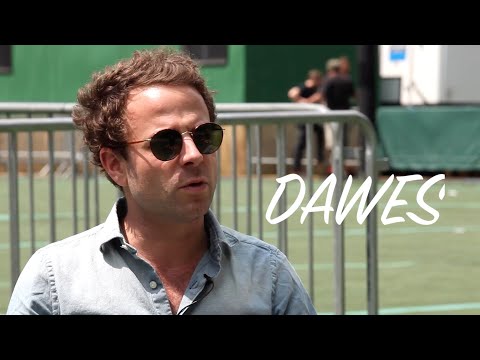
13:51 total
For licensing inquiries please contact reelinintheyears.com. How licensing works →
AUDIOListen
Episode #684 · DawesJuly 2014 · 00:14:11
TRANSCRIPTRead
Show full transcript
0:00And she thinks most people don't have enough of that. Your record came out like a year ago, and I do want to talk about it, because last summer I should have talked about it, but we were doing blues trivia and we were doing different things. So you were talking about what you said: you wanted to be more complex with color and nuance when it came to songwriting. And I've always wondered with bands how you toe the line between complexity and simplicity when writing songs, and not wanting to go too far.
0:46Yeah. I mean, I guess it just depends on where you're at, not only as a writer, but also as a listener. There are times where I've listened to classics, like "Still Crazy After All These Years," and it's like, well, there's a lot of chords going on. I'm not in a place to really receive that information. And then at another time, it's like, man, there is just nothing better than how beautifully orchestrated this song is. So it just depends on what you're looking to hear. When I was writing that album, there were a lot of, it's like, oh, how do I come up with some sort of suspension and release in a new way, or bring in these non-chord tones, or whatever. Just to play with songwriting in a way
1:31that I hadn't done on the first two records. But it's funny, because even now, when I look at the new songs that we have for, because we have a whole bunch of new songs for our fourth record that doesn't exist, we've pulled a good amount of that back. A lot of the chord stuff is a lot simpler. In some ways, the songs are more ambitious, but it's not in a color way. It's not in a chordal, musical kind of way. Yeah. Sonically, what was that? "Hey Lover." That one's different too. Yeah, well, that song, yeah, that's our good buddy Blake Mills' song. He wrote that song. He put it on his first record. And he's one of the greatest musicians
2:19that we've ever met, but he doesn't tour that much, so a lot of people hadn't heard that song. And we love him, we love that tune. It would be fun to throw this one on there. So we did it in the spirit of when you see the old Willie Nelson records covering his good buddies and stuff. We just thought it'd be fun to do that. And I do feel like it really holds a cool place on the record, because it's like, I don't know, maybe to a certain extent, it's pretty clear that it's not OK. They're all covered in their ears. I have a feeling this is going to suck. Yeah. Oh. OK. So you were saying? Well, yeah, I just feel like it really added a different perspective to our record, just because it was clearly coming from a different place.
3:05Yeah. Is it safe to say when we hear your voice, you're writing those lyrics? Or are you writing for him? Yeah, he writes all the lyrics. He writes everything for you? "I'm not going to sing that. I don't like that." No, I have an implicit trust in everything that he writes. What about with sounds Jacquire was doing? Because I wrote down one of the snare sounds on, sorry, I did this all on the plane this morning, "Something in Common." It's such a weird snare sound, but it's so awesome at the same time. Yeah, that's a little drum that I have that's just kind of like a toy that gets a strange sound. It was like a snare drum toy? Like a kid's little thing? Yeah, and that was actually something we had before we even went into the studio. We demoed that song with somebody else before.
3:50We worked with Jacquire and it was a similar thing. Yeah, and it's cool, because if you listen to that song, Griffin switches the snare into a proper snare once the band really kicks in. So it's cool to hear it go from the little dinky toy to the... Is that? It probably isn't. So what's the weirdest instrument you guys screwed around with trying to get on the record? I think we're relatively tame when it comes to getting experimental, just because I feel like for us, the kind of music we make, there is a certain amount of tradition to it, of how to just play guitar better, how to play drums better. It's not, "Let's pick up this weird thing," you know, like bagpipes, "we don't know how to play it, let's just put it on there." For us, something like that, or a saxophone or a Mellotron sound, is like...
4:37For us, we're like, well, this is exciting. And, you know, we continue to want to push that. We've been screwing around with different synths and sounds and baritone guitar and stuff that we hope to incorporate to a larger extent. But I guess at the end of the day, for a band like us, when we sound our best, it's really just when we're honest with the fact that we're four guys that play what we play. And when we're doing that, when I'm on guitar and he's on drums, and bass and keyboards, that's when it's Dawes. So we don't really wander into too many different instruments. What are things sounding like for these songs you're writing for the future? Can people hear them on the road this summer? Yeah, we'll play some. We've been playing them quite a bit.
5:23We're gonna try to... That's one thing we didn't really do with Stories Don't End. We didn't really play much of it out, whereas the first two were... They weren't ready before? Or they just didn't... We just didn't arrange them. Gotcha. Yeah, nothing is wrong. Our first record, North Hills, obviously was our first record. Like any band, we were touring, or not touring, but playing a lot of shows when we made it. But with both of our other records, we played so much of the material live. And we thought it'd be fun to do that again for this record, just to keep things shifting and changing. How much have those first songs changed in arrangement since then, just to keep them interesting for yourselves live? You mean the North Hills stuff, or even something off the other one? Which is not coming to me right now.
6:08All of them, I think, probably. But it's imperceptible when you're playing them every night. After being on the road for six months and playing one song every night, or close to every night, only then can you go back and listen to the record version and be like, wow, this is drastically different than how we recorded it. Or, I wish we would have known then what we know now about this song and about this arrangement. So I think for us at least, it benefits us to have songs on the road before we go to record them in the studio. The first single on this last record of ours was one of two. Yeah, it was one of two that was being played.
6:54And I think that that's kind of evident. At least from my perspective, going back and listening to it, that one seems much more developed. Interesting. What have you learned about yourself as a songwriter going back and listening to the old songs? I've learned that it's interesting. I think there's a big difference with how I sing. And maybe every songwriter or singer has this. I mean, it's the same thing as when you hear a voicemail you've left for someone and you're like, whoa, that's what I sound like. Or even stories you were writing where you maybe didn't get it at the time, and now you're just like, that's what I meant? That happens a little bit.
7:40It definitely happens. I think my songwriting has been less of this sort of let-it-wash-over-me thing. It's been more of, I want to write a song about this, and then I set out to do that. And then sometimes something that isn't working for me at the time, I go back and go, I really like that. I'm glad I stuck with that, because I like that line, or something like that. But for the most part, with heroes like John Prine, it's a little more clear, like, oh, this is what the song's about. Rather than, whoa, these images flying by, and it's like, I don't know what I was writing, I just wrote it, and then it presented itself later. There are those songs, I feel like, throughout our records, I don't know, "When You Call My Name" or whatever it is.
8:27But there's less of that than maybe for other kinds of writers. I don't know, like Conor Oberst or something, where it is a very visceral experience a lot of times, where he's even said, I don't know what they were about when I was writing them. What have you learned about songwriting, I guess for both of you, from playing his stuff? I mean, writing your musical parts. I mean, he's always been a hero in terms of a songwriter for me. So just to learn the inner workings of his material and to see how he arranged his stuff, see how he puts phrases together, and then to see how he takes those songs and puts them on stage. Yeah, it's really taught me a lot. You know, you don't notice.
9:13Like, oh, he'll put the bridge after the first chorus. Not a lot of people are doing that, he does it kind of regularly. Or he'll do a certain kind of chord change that you hear throughout different songs that I never noticed before. It's like, oh, he's got his signatures that I guess are always clicking in people's heads, but they're not necessarily aware that that's what they're picking up on. I did want to ask you, just before we go, about bookending the record with the... Because no one knows how to say the word. Reprise, reprise. Reprise, that's what I say. You both say reprise. Okay. But they're drastically different versions of it. Yeah. That's interesting. Well, it's funny, because I wrote it as you hear it as the first track, and I just felt like the song wasn't done. I felt like I wanted to turn it around one more time. And so I wrote the last verse and last chorus,
10:00and I changed the words of the last chorus. And at that point, it was like seven and a half minutes of a lot of words, just so many lyrics. And as much as I love, you know, Bob Dylan songs or Leonard Cohen songs or whoever it is that do that sometimes, I just felt like, for that song, it just wasn't feeling right for us to just plow through seven and a half minutes, or whatever it was, of just this one long "Just Beneath the Surface." And then I started thinking, because what you hear as track 12 was written considerably later, I thought, well, maybe there's something that could be cool about that, because I do feel like, thematically, there's a lot about what this song's getting after that you can find through the other songs.
10:47Maybe it would be cool to put it at the end and come up with a different arrangement for it and just kind of bring it back around. And I'm really, really happy with the way that came out. Whenever we do little acoustic performances, or sometimes when we play it live, we're working on versions of it live, we put them back together and do this long version. But for the most part, we're really happy with the way it came out. How do you know when a song ends? I mean, when it's done. I mean, the record's called Stories Don't End, but songs need to, right? At some point you just need to be like, okay, it's good now. Yeah, I don't know. Maybe Alfred has a question this way. What was the hardest one to be like, okay, now I think it's done? Yeah, well, I guess that one, because, I mean, there was a finished song and then I still was like,
11:33I feel like I've got to keep writing it. And then there's other songs where you just know that it's short and that's fine. Well, what was easiest? Like, we have this song of ours, "If I Wanted Someone." It's like a verse, chorus, then half a verse and then another chorus, and there's no bridge, there's no third verse, and that's very little for me normally. Normally there's a bridge or third verse or something. And with that one, I was like, I just feel like that's the thing it needs to say. Just repeat the chorus again and I think it's done. And then other songs, like "A Little Bit of Everything," I wrote the three little stories, where there's a guy jumping off a bridge and an old man and then
12:19people getting married, and I was like, I still don't think that it's done. I don't know if it's kind of ridiculous or not, but I want to have one more chorus where I try to tie the whole thing back together, where it's not regarding one of the little stories. And so I wrote that last chorus, and I didn't really know, it was like, is this overboard or what? But I mean, I'm glad we put it in there. But yeah, there's moments like that where it's like, I guess it could be done, but there's just sometimes, not always, but with that song or "Just Beneath the Surface," where I feel like there's not a period on it yet. There's not an ending. And I like that satisfaction that comes from when you know a song is over. Like, you know, hearing Thom Yorke say at the end of Kid A, "I'll see you in the next life."
13:09It's like, that's conclusive. That feels like not only the end of the song, but the end of a record, or whatever it is. It's a good way to end this. But we do five questions, five quick questions, one-word answers. So. Road or studio? Road. Road. Lennon or McCartney? Lennon. Lennon. When you hear a song, what usually hits you first: lyrics, melody or rhythm? Lyrics. If someone's never heard Dawes before, what song do they start with? "Someone Will." Not cool. Little acoustic one. It's two words. Yeah, that's all we've got. You agree with them? I don't know. I don't know. Maybe "Something in Common." I don't know. Okay. In one word, Dawes. Dawes. Clever. Band.
14:00Okay. Is that the Empire State, or? I don't think about that. No, it's just... No, it's going to be like, that's very appropriate for where we are right now. Mm-hmm. Yeah. Get that out. Get that. Thanks, guys. Yeah, right on.
ABOUTThe archive
This interview is part of the Matt Schichter Interviews archive: more than 700 conversations with musicians, actors and filmmakers recorded between 2003 and 2014, beginning with The BackStage Pass, one of the first podcasts (2003). The archive also became Matt's short documentary Lennon or McCartney. Matt Schichter is now a Glasgow-based producer, line producer and music documentary director: he directed CFNY: The Spirit of Radio (PBS, TVO) and line produced Faith (TIFF and Rome 2026). His films → · UK film producer and line producer → · More about Matt →
Listen to the full archive on Apple Podcasts or Spotify.