Lennon or McCartney? Jenny Lewis’ answer: Harrison. Watch the moment. See every artist’s answer. Take the quiz.
SONGSWhat Jenny Lewis said about the songs
“Acid Tongue”
Jenny Lewis described how "Acid Tongue" came to her and who sang the live background vocals.
“Man, that song just kind of spilled out of me. Some are harder to catch or wrangle, but that one, I don't know where it came from. But the background vocals on that song, which we recorded live, I'm playing and singing, and then it was Jonathan Rice, Chris Robinson of the Black Crowes, and Farmer Dave Scher”
“She's Not Me”
Jenny Lewis explained that "She's Not Me" was written in open G tuning and was the first song she recorded with Ryan Adams.
“'She's Not Me,' it was in an open G, Keith tuning... I was messing around in this tuning, and he understood immediately what to do with that song, to, like, make it feel more like the Stones disco than, like, a cheesier side of disco.”
“Aloha & the Three Johns”
Jenny Lewis said "Aloha & the Three Johns" came from a disastrous band trip to Hawaii.
“I recorded it three times and finally hit it with Ryan Adams... And it was based on an ill-fated trip to paradise, to Hawaii, where I wanted to basically gift my band a trip to Hawaii on our way back from Australia to break up the flight. And when we got there, they put us up in the worst possible hotel”
“Love U Forever”
Jenny Lewis explained that the title lyric came from a mistake that Ryan Adams told her to keep.
“I flubbed the lyric and I sang 'love you forever.' And he was like, stop... That's the song. I was like, no, that's not the song. It's 'love him forever.'... Then I realized, in my own life, it's very hard for me to say 'I love you.' And so of course I was hiding behind, oh, 'love him forever,' not 'love you forever.'”
VIDEOWatch
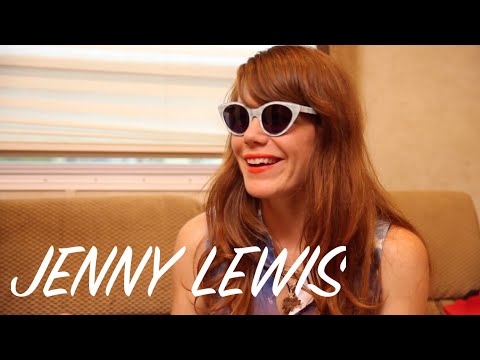
2 clips · 13:59 total
For licensing inquiries please contact reelinintheyears.com. How licensing works →
AUDIOListen
Episode #677 · Jenny LewisJune 2014 · 00:11:24
TRANSCRIPTRead
Show full transcript
0:03Is this like the first show of the, like, it looks like you're on the road all summer, and this is like the first one? I know you did probably a couple of one-offs here and there, but this is, yeah, this is kicking off this one. It was feeling good to be back on stage and playing these tunes. Feels good. Crafting a set list and all that stuff. It's a work in progress, you know. Is it? Well, it is, because in your mind you can go over a set list a hundred times, but until you're up there,
0:50you're actually feeling it in front of a crowd. So today I thought there was a little, I could, like, throw in a rocker or two. But I'm having to balance material from such an extended period of time. Well, I noticed "Close Call" went into "The Moneymaker." Yes, it does on the record too, right? Oh, does it? Doesn't it? Or maybe my [inaudible]? Okay, you don't know. I don't know. I think it does go [inaudible]. But see, I ordered that too, so you do what you do. But I'm wondering, like, were those, so I guess they didn't have to be back to back. I just thought, oh, so maybe she wrote it and, like, they were meant to be one piece kind of. Well, yeah, I wanted to create a little consistency in the set, like, this is this particular era. Okay, you know, and thematically they work well together. Okay, but that wasn't a goal, like, even when you're writing the songs, like, these two need to sit back to back? To go back seven years. We'll talk about the new record.
1:36What was I doing back in 2007? But let's talk about The Voyager. Okay. Because I hear it was a tough record to make. So are they hard to perform on stage? Not yet, because they're not all in there. Okay. And I'm slowly, because the record is not out yet. Yeah. So you have to kind of, like, slowly introduce people to the new record in a live context. Or you'll hate your new material because they're like, oh, interesting. In the crowd, like, but yeah, but they're hearing it for the first time. Yeah. You can't expect people to, like, freak out, because they're actually really listening. And today the crowd was so attentive, you know, they were really listening to the lyrics. But I think it's time for another newie. Okay. So as you go through the summer you'll start to bust them out a little bit. So you were talking to Brian from The Gaslight Anthem yesterday.
2:22You played the festival, and his record comes out in August. And he said he doesn't want to play anything until that record's out, because of YouTube and all the, like, you know, the way stuff leaks out nowadays. It sounds like you feel a little the opposite. I don't really think about that stuff. You know, I play what I want to play and what makes me feel good in the moment. And, like we were talking about, just crafting a set from, like, 15 years of music. You know, it's a very careful process, you know. But I want a fair amount of new stuff to be in there so I remain interested. Sure. You know, because it's always the new stuff that is the most exciting, I think, to play. Well, here's a song about Metallica. And there's a song about a comically bad vacation as well. Yes. So tell me about the, let's start with the comically bad vacation, because that sounds fun. That one I wanted to put in the set today, but I chickened out.
3:08Oh, let's do that. I love that song. I recorded it three times and finally hit it with Ryan Adams, who produced most of The Voyager. He really understood the vibe of that tune. But it's called "Aloha & the Three Johns." And it was based on an ill-fated trip to paradise, to Hawaii, where I wanted to basically gift my band a trip to Hawaii on our way back from Australia to break up the flight. And when we got there, they put us up in the worst possible hotel in, like, Methtown, Waikiki, which I didn't even realize there was, like, a Methtown.
3:53Just, like, prostitution, ice. I think that's what the kids call it now. Oh. These days, ice. Okay. And then the craziest thing happened, where I was walking with Jonathan and we were on the main drag in Honolulu. And we look across the way, and there's a guy standing on the corner who looks very thirsty. And he then proceeds to unzip his pants. You may have to censor this for the kids. And then he pees directly into his own mouth. No. On the corner of the main drag in Honolulu, I can't pronounce it because all the streets sound alike there.
4:38And I just thought, this is just the worst vacation. We'll talk about this after, but how does he even do that? No, he's a magician, clearly. And very thirsty. And, like, a surfer kind of guy, I don't know, but it was, like, just the end to, like, the worst week in paradise. Good fodder for a song, though. Wow. Right. So that I didn't, I tried to write that into a verse, but I couldn't quite. That's the subtext. Gotcha. Talking about Ryan, though, I heard he wouldn't let you listen to playbacks. No. Is that something you think you want to take into, like, the process now? That's such a different way of working. I know, but that's the joy of recording. Do you like it, though? Because, I mean, obviously it's different. Well, I needed that, I needed a new way of doing things, and I needed a guide. And I was in his studio, so I was going to play by his rules, begrudgingly sometimes,
5:26but I thought it was really, really smart for me at that moment, because I was stuck. And I really didn't need to look back. I needed to just keep looking forward with the songs. He really helped me out a lot. What song did he help the most on? He understood, well, the first song I recorded with him, "She's Not Me." I wrote it in, it's a good closer, by the way. Oh, thanks. Well, it's a good, it kind of feels uplifting. Which, all of my songs don't necessarily feel that way. No, really? Today I was, like, singing about, like, something so dark, and I looked out, I was like, why? What am I doing? This is so dark. I like that. But maybe it kind of, people don't totally listen to all the words.
6:13But "She's Not Me," it was in an open G, Keith tuning. I just read Life. I don't know if you read it. I started it. I jump from book to book, so I'm like 60 pages in. It's so good. It gets even better, even though the early stuff is really interesting. But so I was messing around in this tuning, and he understood immediately what to do with that song, to, like, make it feel more like the Stones disco than, like, a cheesier side of disco. Yeah, no, I mean, the [inaudible] stuff. Yeah, exactly. So, yeah, that was actually the song. We were only supposed to record one, and by the end of the day he asked if he could recut my whole record at PAX-AM. Oh, that's cool. And so I let him. For the best. Oh, yeah. I mean, I don't know if he'd ever want to work with me again. You just had to have a little tiff?
6:59Well, we're a lot alike in some ways, and we clashed a couple times. I don't know if he'd want to deal with me again, but I'd be up for it. You heard it here, Ryan. [inaudible] "Love U Forever," and from the rest of the record. Him changing those words for you? Yeah, he changed them. Well, we were recording live and we only had a couple passes at each song. So you had to get it right, because he wouldn't allow us to do more than two takes of a song. So that one, I flubbed the lyric and I sang "love you forever." And he was like, stop, love, love. That's it. That's the song. I was like, no, that's not the song. It's "love him forever." Don't you see it written down? It's "love him forever." He's like, no, Lewis, that's, like, the direct, that's, like, heartbreaking.
7:44"Love you forever," to say that to someone. Then I realized, in my own life, it's very hard for me to say "I love you." And so of course I was hiding behind, oh, "love him forever," not "love you forever." I have a whole psychological analysis on you now, but we can do that some other time. It's a slippery slope. We were talking about "Acid Tongue" before, and I've heard you say it's, like, one of your most, like, what do you want to, I have it written down somewhere, what I said. Some bullshit. No, no, no, it was good. It was good. I was talking. Okay, well, whatever. You're very close to that song. I don't know where it is anymore. But as I was listening to it live today, and I remember when the record came out being like, how did you come up with that vocal melody for, like, the third line of the chorus, where it keeps going up? The background vocals, you mean? No, even, like, your stuff. My melody? Man, that song just kind of spilled out of me.
8:34Some are harder to catch or wrangle, but that one, I don't know where it came from. But the background vocals on that song, which we recorded live, I'm playing and singing, and then it was Jonathan Rice, Chris Robinson of the Black Crowes, and Farmer Dave Scher, one of my best friends. So I had that kind of dude power. You can hear Chris in there. He's pretty, like, Chris Robinson. Yeah. He's wailing. Nice. I think our time is almost up, sadly. Oh. We've got to do five questions. Five quick questions. Oh, okay. One word answers. Okay. Road or studio? Road. Lennon or McCartney? George Harrison. Cool. When you hear a song, what usually hits you first: lyrics, melody, or rhythm? Lyrics. If someone's never heard Jenny Lewis before, what song do you start with?
9:22"Acid Tongue." Jenny Lewis? Weird. Weird? It's good. I like that. Totally weird. Thank you. Thanks. Appreciate it. Thank you. Cool. Good talking to you. Great combo. Yeah. I tried, not here. Carl Sagan's Cosmos influenced the record. He actually did. And I... He did, from beyond. I'm not going to ask you more questions. She's going to go through the list. From beyond the grave. Have you seen the new one? Have you started watching the new one yet? I haven't seen the new one yet, but I hear it's great. I've watched the old one on a loop. And I moved into a house in Laurel Canyon. And... Yeah, we're good, Dave. The books were in the library from the previous people that lived there and built the house.
10:07And one day I was going through the books. Oh my gosh, Cosmos. And I opened it up and it was a signed copy. Oh, wow. Carl Sagan to the woman who built the house. That's amazing. Let's see. One more here. Sings about listening to Metallica. True. We did that already. Go to the Girls one. I like the Girls one. Where's the Girls one? When you write a song for Girls. Oh. How does it change? Like, when you have a goal in mind for a song, how does the writing change? Well, I don't know if I write actual questions. Well, that's interesting, because they called me in and they wanted me to... They wanted to show me an episode out of order. And I'm a fan of the show. Oh, that's hard. And I was like, I don't know if I can do that, guys. Like, you're asking me to come in, and they assured me that it was a kind of standalone episode from season three. So I went in and watched the episode, and simultaneously my friend Rostam from Vampire
10:57Weekend sent me this beautiful track. And so I kind of took the episode and the track and then fused the idea. But mostly that song is about feeling like a werewolf. And I synced it up with Teen Wolf, the scene where he's, like, becoming a werewolf, and sent it off to Rostam. I was like, listen and watch it at the same time. It's like the Dark Side of the Moon thing. Exactly. And you're not feeling like yourself. That was a good hit ending. That was a good hit ending.
ABOUTThe archive
This interview is part of the Matt Schichter Interviews archive: more than 700 conversations with musicians, actors and filmmakers recorded between 2003 and 2014, beginning with The BackStage Pass, one of the first podcasts (2003). The archive also became Matt's short documentary Lennon or McCartney. Matt Schichter is now a Glasgow-based producer, line producer and music documentary director: he directed CFNY: The Spirit of Radio (PBS, TVO) and line produced Faith (TIFF and Rome 2026). His films → · UK film producer and line producer → · More about Matt →
Listen to the full archive on Apple Podcasts or Spotify.